Are Basketball Shoes Good for Running? Pros, Cons & Risks

Basketball shoes are fine for short runs, court sprints, and occasional jogging, but they are generally not the best choice for regular or long-distance running. Proper running shoes are designed around repeated forward movement, while basketball shoes prioritize stability, traction, and quick changes of direction.

That does not mean running in basketball shoes is automatically dangerous. Basketball involves plenty of running, and modern basketball footwear can provide substantial cushioning and support.

Running a few laps during basketball practice is different from running several miles on pavement. The longer and more frequently you run, the more useful dedicated running shoes become.

This guide compares both types of athletic footwear, explains when basketball shoes can work for running, and examines what the research says about comfort, performance, and injury risks.

Basketball Shoes vs Running Shoes: What’s the Difference?

Basketball shoes and running shoes share several features. Both need to provide traction, cushioning, and a secure fit.

However, their design choices reflect different sports.

Basketball players regularly sprint, stop, jump, land, and move sideways. A basketball shoe must accommodate these movements while helping the player remain stable.

Most running shoes are built primarily for repeated forward strides. They can vary considerably in cushioning, flexibility, weight, and support depending on their intended use.

Here is how the two types of footwear generally compare.

Feature Basketball Shoes Running Shoes
Main purpose Basketball movements, including cuts, jumps, and short sprints Repeated forward running
Cushioning Designed for court movement and landings Designed for different running demands
Weight Varies; some models have extra structure and weight Varies; many models prioritize running efficiency
Stability Often emphasizes side-to-side containment Usually emphasizes forward-running needs
Flexibility Depends on the shoe’s construction Varies from flexible trainers to stiff racing shoes
Traction Often uses multidirectional court patterns Designed for road, trail, track, or other running surfaces
Durability Depends on indoor or outdoor court design Depends on the intended running surface and shoe

These are general differences, not fixed rules.

For example, some lightweight basketball shoes weigh less than certain running shoes. Similarly, some running shoes have stiff soles, while some basketball shoes allow considerable forefoot flexibility.

The exact model matters more than its appearance or category alone.

Cushioning and Shock Absorption

Basketball shoes need cushioning because basketball involves repeated jumping, landing, and running.

Many models use thick foam midsoles or other materials intended to absorb impact.

However, more cushioning does not automatically mean a shoe is better for running.

Running involves repeated loading across thousands of steps. Running shoes are designed with this movement in mind, although cushioning systems vary widely between models.

A 2018 study involving 18 male collegiate basketball players examined how running speed and basketball-shoe cushioning affected impact loading and tibial shock.

The researchers found that faster running increased the measured loading. They also found that the most heavily cushioned condition did not consistently produce the lowest loading measurements.

This is important because it challenges the idea that softer or thicker soles must always provide better shock absorption during running.

However, the study did not compare basketball shoes directly against running shoes or measure long-term injury rates.

Weight and Running Performance

Extra weight can affect running performance.

Some basketball shoes contain additional materials around the heel, sides, or midfoot to provide stability during court movements.

That can make certain models feel heavier during sustained running.

However, not every basketball shoe is heavy. Lightweight basketball models exist, and running shoes vary considerably in weight.

Research has found that adding weight to running shoes can affect running economy.

In a 2020 study involving 11 trained runners, researchers tested the effects of added shoe mass on running economy and performance.

Adding 100 grams to each shoe had measurable negative effects under the tested conditions.

That does not establish a specific speed penalty for basketball shoes.

It simply shows that footwear weight can matter during running, particularly when performance is important.

For an occasional short jog, a slightly heavier shoe might not be a major concern.

For someone training for a marathon, unnecessary extra weight becomes a more relevant consideration.

Flexibility and Heel-to-Toe Movement

Running involves repeated heel-to-toe movement, although individual footstrike patterns differ.

The foot lands, supports the body’s weight, and moves through the stride before pushing off again.

A running shoe’s shape, sole construction, and bending stiffness can influence how that movement feels.

Some basketball shoes use relatively stiff midsoles, plates, or other structural features.

These features may help the shoe provide stability during cuts and changes of direction.

However, less flexibility is not automatically a disadvantage.

Some modern running shoes also use stiff plates and specially shaped soles to influence running mechanics.

The question is whether the shoe feels comfortable and appropriate for the activity.

A basketball shoe that feels excellent during quick court movements might feel less natural after repeated straight-line strides.

You cannot determine that from collar height or appearance alone.

Lateral Stability and Ankle Support

Lateral movement is one of basketball’s defining demands.

Players repeatedly shuffle, cut, pivot, and change direction while defending or attacking.

Basketball shoes generally emphasize lateral stability to help accommodate those movements.

Running shoes are usually designed around forward movement, although their support systems vary.

That makes basketball footwear useful when a training session combines running with basketball drills.

However, extra side-to-side support does not automatically improve running performance.

High-top basketball shoes are another common source of confusion.

A high collar may change how secure a shoe feels around the ankle, but this does not prove that high-tops prevent ankle injuries.

The American Orthopaedic Foot & Ankle Society recommends considering the demands of each sport when choosing athletic shoes.

For regular jogging, a secure fit and comfortable forward movement matter more than simply choosing the highest ankle collar.

Traction and Durability

Basketball shoes need reliable grip when players stop, turn, and accelerate on a basketball court.

Indoor models often use multidirectional outsole patterns designed for gym floors.

Running shoes use different tread designs depending on whether they are intended for roads, trails, tracks, or other surfaces.
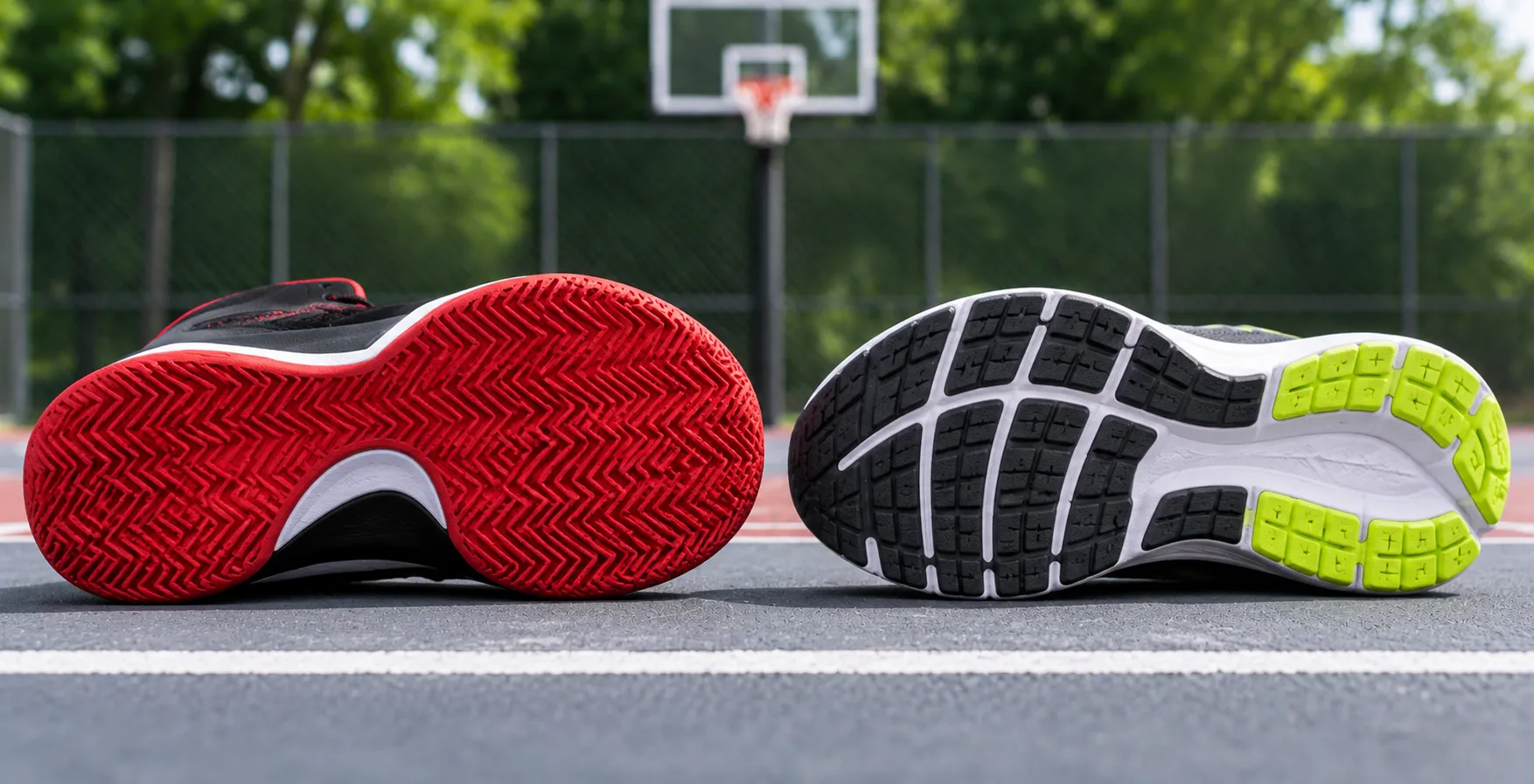
Basketball shoe herringbone outsole beside a running shoe outsole with segmented rubber tread.
Illustrative comparison of basketball and running shoe outsole patterns. Actual tread designs vary by model.

Good indoor basketball traction does not guarantee the same grip on wet pavement or loose gravel.

The playing surface also affects durability.

Under Armour’s outdoor basketball shoe guidance explains that asphalt and concrete can wear down shoes made for indoor gym floors more quickly.

If you regularly run outdoors in an indoor basketball shoe, the outsole may wear faster than it would during normal indoor use.

An outdoor basketball model may handle rough surfaces better.

Even so, outdoor durability does not automatically make it the right shoe for distance running.

When Can You Run in Basketball Shoes?

Basketball shoes can be suitable for some types of running.

The main considerations are distance, frequency, surface, fit, and the specific shoe.

There is no scientifically established distance at which basketball shoes suddenly become unsafe.

Instead, consider how different types of running place different demands on your footwear.

Short Runs and Casual Jogging

Occasional short runs are generally the most reasonable use outside basketball.

For example, you might jog to a nearby outdoor court or complete a short warm-up before practice.

If your basketball shoes fit properly, feel comfortable, and have suitable traction, they may work for these activities.

You do not necessarily need to carry another pair of shoes for every brief jog.

However, pay attention to the surface.

An indoor-only basketball shoe might not be ideal for running along rough pavement, especially if you want to preserve its court traction.

Comfort is another consideration.

A shoe that feels good during a few explosive movements may begin rubbing or feeling restrictive during continuous running.

If that happens, stop rather than forcing yourself to continue.

Short runs can be reasonable, but there is no universal safe distance for every basketball shoe or runner.

Basketball Sprints and Conditioning

Basketball shoes are designed to accommodate running as part of basketball.

That includes quick accelerations, defensive recovery runs, fast breaks, and repeated court-length sprints.

Basketball involves forward movement, backward movement, jumping, and lateral movement, often within a few seconds.

If your conditioning session involves suicides, shuttle runs, defensive slides, and other basketball drills on a suitable court, basketball shoes are generally the logical choice.

They provide the sport-specific traction and stability those drills require.

This is different from wearing the same shoes for repeated sprint sessions on a running track.

Track shoes and sprint-specific footwear may use different designs to suit those surfaces and movements.

Use the right shoe for the actual session rather than assuming all running activities are identical.

Treadmill Running

You can often use basketball shoes on a treadmill, provided they fit properly and are suitable for the equipment.

An occasional short treadmill jog may be comfortable in some models.

However, running on a treadmill still involves repeated forward strides.

The moving belt does not remove the importance of footwear fit, grip, and comfort.

If treadmill running becomes a regular part of your workouts, proper running shoes are generally the better option.

Before using basketball shoes on a treadmill, inspect the soles.

Remove stones, grit, or other debris that could affect the belt or your footing.

Check the gym’s footwear rules if necessary.

Do not assume that a treadmill makes every basketball shoe suitable for running longer distances.

Moderate Running and Regular Road Runs

Regular road running places repeated demands on your feet, shoes, and lower limbs.

Even a moderate running routine can involve substantial mileage over several weeks.

Basketball shoes may feel acceptable at first, but comfort during one short session does not guarantee they will suit repeated runs.

Some models may feel heavy or restrictive.

Others may provide enough comfort for occasional use but wear more quickly on asphalt.

If you plan to run several times a week, dedicated running shoes are a more sensible investment.

They are designed for the movement pattern and surface you will use most often.

You also avoid putting unnecessary outdoor mileage on basketball shoes you want to preserve for games.

Long-Distance Running and Marathon Training

Basketball shoes generally are not the best choice for long-distance running.

You might be physically capable of completing a 5K or longer run in them, but that does not make them ideal.

Running longer distances means repeating similar movements for an extended period.

Small differences in fit, weight, and how the shoe feels can become more noticeable as the run continues.

A basketball shoe that feels secure during a game may feel less comfortable after sustained forward running.

Regular road mileage can also wear down court-specific outsoles.

If you are training for your first half marathon or preparing for a marathon, choose running footwear suited to your training.

That does not mean a basketball shoe will automatically cause injury during a long run.

It means purpose-built running shoes make more practical sense for frequent distance running.

Pros and Cons of Running in Basketball Shoes

Basketball shoes offer some advantages for mixed activities, but they also involve trade-offs.

The benefits are strongest when running is only one part of a basketball workout.

Advantages

Convenience

One pair can cover shooting practice, court sprints, warm-ups, and short occasional runs.

This can be useful when you do not want to carry multiple pairs.

Court-specific stability

Basketball shoes provide stability for movements involving stops, cuts, and changes of direction.

That makes them suitable for conditioning sessions that include basketball drills.

Cushioning

Many modern basketball shoes include substantial cushioning.

However, the amount and type of cushioning differ between models, and cushioning alone does not determine running suitability.

Familiarity

If you regularly play basketball, you may already feel comfortable in your basketball shoes.

That familiarity can make them a practical option for brief activity.

However, comfort during basketball does not automatically mean the shoes will feel equally good during a long run.

Disadvantages

Possible extra weight

Some models contain additional materials for support and stability.

That extra weight may be less desirable during sustained running.

Different movement priorities

Basketball shoes are generally built around multidirectional movement rather than repeated forward strides.

Some models may therefore feel less natural during steady jogging.

Outdoor outsole wear

Running on concrete or asphalt may wear down indoor basketball shoe traction patterns.

This is particularly relevant if you want to keep the shoes for hardwood court use.

Possible comfort issues

A shoe might rub, feel restrictive, or allow unwanted heel movement during longer runs.

The response depends on the fit, model, and individual runner.

Cost of replacing shoes

Regular running adds wear.

If you use an expensive basketball pair for both frequent road runs and court play, you may eventually need to replace it sooner.

The tradeoff is not always worth it when a separate running pair would better serve your needs.

Can Running in Basketball Shoes Cause Injuries?

Running in basketball shoes does not automatically cause injuries.

However, wearing shoes that fit poorly or feel unsuitable for your activity can contribute to discomfort.

Common concerns include knee pain, shin splints, ankle problems, and foot pain.

What Does the Research Say?

A 2022 Cochrane systematic review examined whether different types of running shoes affected lower-limb running injuries.

The review included 12 trials involving 11,240 participants.

Researchers found that much of the evidence comparing different running-shoe categories was uncertain.

Importantly, the review did not identify trials directly comparing running shoes against non-running shoes.

That means the findings cannot tell us exactly how injury rates differ between basketball shoes and proper running shoes.

There is also no reliable universal figure showing that basketball shoes increase running injuries by a particular percentage.

This does not mean footwear is irrelevant.

It means the evidence is not strong enough to make categorical injury claims.

Shin Splints and Knee Pain

Shin splints and knee pain can occur during running for several reasons.

Training volume, previous injuries, changes in activity, running surfaces, and individual movement patterns may all matter.

Footwear comfort and fit are also relevant.

However, it would be misleading to claim that basketball shoes directly cause shin splints or knee problems.

The research reviewed for this article does not establish that relationship.

If you develop pain during running, assess the whole situation rather than immediately blaming one feature of your shoes.

For example, suddenly increasing the distance or frequency of your runs may be relevant.

The same applies if your shoes feel uncomfortable or no longer fit securely.

Ankle Support and Injury Prevention

Basketball players often choose shoes partly for ankle support.

Some prefer high-tops, while others feel more comfortable in low-top models.

However, a taller ankle collar does not guarantee protection against ankle sprains.

Likewise, a high-top basketball shoe is not automatically safer for running than a low-top shoe.

Running generally involves different movement demands from repeatedly cutting and landing during basketball.

The best practical approach is to choose footwear that fits well and suits the activity.

If you experience persistent pain, swelling, or localized discomfort, stop running and seek advice from a qualified healthcare professional.

Do not continue running through increasing pain because you assume your shoes must be safe.

Does Running Damage Basketball Shoes?

Running does not automatically damage basketball shoes.

They are made for athletic movement, and running is part of basketball.

However, running outside the shoes’ intended use can increase wear.

Outsole Wear and Court Performance

Indoor basketball shoes are often designed for clean gym floors.

Their outsole patterns are intended to provide grip during basketball movements.

Asphalt and concrete can be more abrasive.

Repeated outdoor running may gradually wear down the rubber or reduce the depth of the traction pattern.

This can matter when you return to an indoor basketball court.

A worn or dirty outsole may feel different from a clean, unworn one.

However, there is no established number of road miles that guarantees a specific loss of basketball performance.

One short jog will not necessarily ruin a pair of shoes.

The concern is accumulated wear, particularly when using indoor-only basketball footwear on rough surfaces.

Cushioning and General Wear

Running also adds repeated use to the midsole and upper.

Over time, athletic footwear can lose some of its original feel as materials wear.

However, the rate depends on the design, conditions, and how frequently you use the shoes.

Do not apply running-shoe replacement mileage directly to basketball shoes.

There is no reliable universal mileage limit for basketball footwear used for running.

Instead, inspect the shoes regularly.

Look for worn tread, damaged materials, loose sections, or changes in how securely they fit.

If you regularly play indoor basketball, keeping a dedicated court pair can help preserve it for that purpose.

Tips for Running in Basketball Shoes

If basketball shoes are your only available footwear, you do not necessarily need to avoid every short run.

Use them carefully and pay attention to how they feel.

1. Check the Fit Before Running

Your toes should have enough room to move.

The heel should feel secure without excessive slipping.

Do not assume that uncomfortable shoes will become suitable after a long break-in period.

2. Inspect the Soles

Check for worn traction, tears, loose materials, or objects stuck in the tread.

Avoid running in shoes that are clearly damaged.

3. Start With a Short, Easy Run

Do not begin with a long-distance session simply to test whether the shoes work.

Start modestly and see how they feel.

There is no universally approved safe running distance for basketball shoes.

4. Choose an Appropriate Surface

A flat, dry, predictable surface is easier to assess than wet pavement or loose gravel.

Check whether your specific basketball shoes are intended for indoor or outdoor use.

5. Pay Attention to Comfort

Notice rubbing, heel movement, pressure around the toes, or pain.

If the shoes feel unstable or uncomfortable, stop and reconsider your footwear.

Comfort is useful feedback, although it cannot guarantee injury prevention.

6. Avoid Unnecessary Road Mileage in Indoor Shoes

If you want to preserve your basketball shoes for hardwood courts, limit unnecessary outdoor use.

Regular road running may gradually wear down their traction.

7. Consider Separate Shoes if Running Becomes a Habit

If you start running several times per week, a comfortable pair of dedicated running shoes is generally a better long-term choice.

You do not need the most expensive model.

Focus on proper fit, intended use, and the surface where you usually run.

When Should You Choose Running Shoes Instead?

The right shoe depends on which activity you do most often.

If you mainly play basketball and occasionally complete short runs, basketball shoes may be enough.

If you mostly run, proper running shoes make more sense.

If you regularly do both, owning two separate pairs is worth considering.

For more basketball-specific gear, see our basketball training equipment guide.

For basketball, use footwear designed for court traction, jumping, landing, and quick directional changes.

For regular running, use footwear designed for the surface and type of running you do.

That might mean a daily road-running shoe, a trail-running shoe, or another specialized model.

Track shoes are not automatically the right choice for road running simply because they are made for runners.

Likewise, a basketball shoe is not automatically suitable for every running activity just because basketball players run during games.

Consider the actual activity rather than buying based on appearance, price, or brand alone.

For example, Nike and other major manufacturers make both basketball and running footwear.

A model’s intended purpose matters more than the logo.

The best choice is footwear that fits properly, feels comfortable, and is appropriate for your main activity.

Frequently Asked Questions

Can you run a mile in basketball shoes?

Yes, you may be able to run a mile in basketball shoes if they fit properly and feel comfortable.

A single mile is not automatically dangerous, but there is no scientifically established safe-distance limit that applies to everyone.

For regular running, dedicated running shoes are preferable.

Can you run a 5K in basketball shoes?

It is possible, but basketball shoes are generally not ideal for repeated 5K runs.

Running longer distances involves sustained forward movement, and dedicated running footwear is usually the more practical choice.

A 5K is not a proven injury threshold for basketball shoes.

Are basketball shoes good for sprinting?

Basketball shoes are suitable for the short accelerations and sprints involved in basketball.

For repeated track sprinting or specialized speed training, footwear designed for that activity and surface may be more appropriate.

The exact shoe and training conditions matter.

Can you wear basketball shoes on a treadmill?

Yes, basketball shoes can often be worn on a treadmill.

They should fit securely, provide suitable traction, and meet the facility’s rules.

For regular treadmill running, proper running shoes are generally preferable.

Are high-top basketball shoes better for running?

Not necessarily.

High-top shoes may feel more supportive around the ankle, but collar height alone does not determine running comfort or injury risk.

Cushioning, weight, fit, outsole design, and the individual’s needs also matter.

Can you use running shoes to play basketball?

You can perform some basketball activities in running shoes, but they are generally not ideal for full games.

Basketball involves lateral movement, sudden stops, and jumping.

Shoes designed for basketball usually provide more appropriate court-specific traction and containment for those demands.

Are basketball shoes good for walking?

Some basketball shoes can be comfortable for everyday walking.

However, weight, fit, cushioning, and personal comfort vary between models.

A shoe that works for short walks may not be the best choice for long walking days.

Will running outside ruin indoor basketball shoes?

Not necessarily.

One short outdoor run is unlikely to guarantee damage, but repeated use on rough pavement can increase outsole wear.

If maintaining indoor court traction is important, reserve your indoor basketball shoes mainly for gym floors.

Final Verdict: Are Basketball Shoes Good for Running?

Basketball shoes are good for running as part of basketball. They can also work for occasional short jogs when they fit comfortably and suit the surface.

However, they are generally less suitable for regular road running, long-distance training, and marathon preparation.

The main differences involve movement demands, shoe weight, traction, comfort, and durability.

There is no strong direct evidence proving that running in basketball shoes automatically causes injuries.

If basketball is your main sport, use basketball shoes. If running becomes a regular activity, choose proper running shoes.
Basketball Rack | Types, Sizes, Prices & Buying Guide

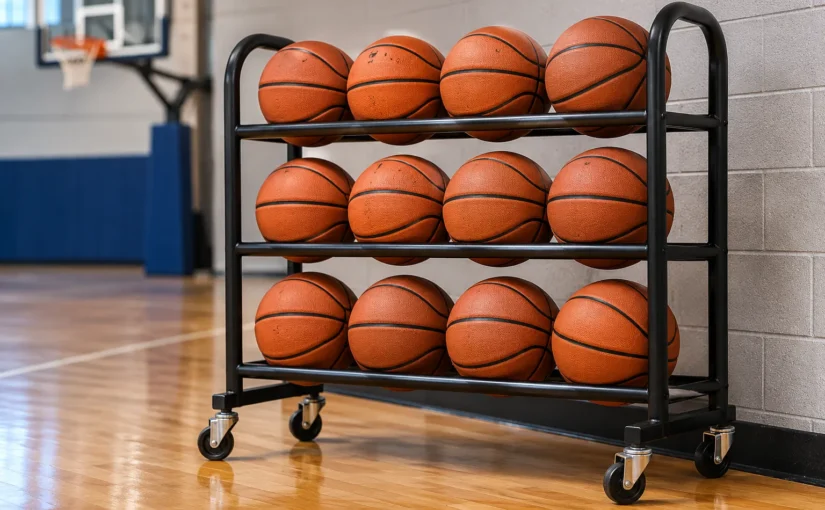
A basketball rack keeps basketballs organized, off the gym floor, and easy to access. It can help coaches run drills, schools manage sports gear, and homeowners keep their garages tidy.

The right basketball storage rack depends on how many balls you own, your available space, and whether you need wheels or locks. This guide explains the main types, sizes, prices, and features worth considering.

For other useful practice accessories, see our guide to basketball training equipment.

What Is a Basketball Rack?

A basketball rack is a storage unit designed to hold multiple basketballs. Most use metal rails, shelves, or enclosed compartments.

Basketball ball racks are common in schools, gyms, recreation centers, and home garages. They help keep balls from rolling across the floor and make equipment easier to find.

A ball rack usually has open shelves or rails. A ball cart is designed for moving equipment, while a ball locker adds security through locking bars or an enclosed cage.

Types of Basketball Racks

Stationary Basketball Racks

Stationary racks stay in one place. They’re suitable for equipment rooms, garages, and gym storage areas where balls don’t need moving frequently.

Rolling Basketball Racks

Rolling racks have wheels that let coaches transport basketballs between storage areas and courts.

Many use two or three tiers, making basketballs easy to grab during practice while keeping unused balls organized.

Wall-Mounted Basketball Racks

Wall-mounted racks save floor space by attaching to a suitable wall.

They’re useful in smaller gyms and garages. However, installation requires the correct mounting hardware and adequate wall support.

Vertical Basketball Storage Racks

Vertical racks store balls in a taller arrangement with a relatively small floor footprint.

They work well where floor space is limited, although reaching balls near the top may be less convenient.

Lockable Basketball Storage Cages

A ball locker protects equipment using an enclosed frame, locking lid, or locking bars.

These are useful for schools, teams, and shared facilities that need controlled access. Some models require a separate padlock.

Folding Basketball Carts

Folding ball carts usually have a fabric or mesh basket supported by a collapsible frame.

They’re convenient for coaches who need portable storage during practice and want to fold the cart away afterward.

Rack type Main advantage Best suited for
Stationary Simple storage Garages, equipment rooms
Rolling Easy movement Schools, coaches
Wall-mounted Saves floor space Small gyms, garages
Vertical Compact footprint Limited storage areas
Lockable cage Equipment security Shared facilities
Folding cart Portable and compact Training sessions

How Much Does a Basketball Rack Cost?

Basketball rack prices vary depending on capacity, materials, mobility, and security features.

Here are examples from US manufacturer and retailer listings checked in November 2026.

Basketball rack Capacity Listed price
BSN Sports 12 Ball Wide Body Cart 12 balls $119.99
Pro Down Wall Mounted Ball Rack Up to 18 balls $174.99
BSN Sports E-Z Fold Cart 20 basketballs $199.99
Trigon ProCage CART315 15 balls $294.58
BSN Standard Portable Ball Locker 20 balls $499.99

Prices may change. Shipping, taxes, availability, and selected product options can affect the final cost.

For a home garage, a simple storage organizer may be enough. Schools and athletic directors may need heavier-duty equipment designed for frequent use.

How to Choose the Right Basketball Rack

Basketball Capacity

Count how many basketballs you need to store before buying.

A 12-ball rack may suit a small training group, while a school or sports club might need a larger cart or multiple racks.

Always check whether the advertised capacity applies to full-size basketballs.

Rack Dimensions and Height

Measure your available storage space, including clearance around doors and walkways.

For example, the Jaypro Atlas BBABC-1 measures approximately 51.5 inches long, 18 inches wide, and 36 inches high.

A rack’s height depends on its design. There is no single standard height for every basketball rack.

Materials, Heavy-Duty Construction, and Durability

Commercial basketball racks commonly use steel tubing with protective finishes.

Look for secure connections and materials suitable for your intended environment.

For daily school or gym use, choose a heavy-duty rack designed for frequent handling. However, a heavy-duty design doesn’t automatically mean the rack is suitable for outdoor storage.

Wheels and Brakes

Wheels make it easier to move basketballs between courts, storage rooms, and practice areas.

Check whether the wheels suit your gym floor and whether the model includes brakes. Don’t assume every rolling rack has locking wheels.

Indoor and Outdoor Sports Gear Storage

Indoor basketball racks should generally stay in dry storage areas unless their manufacturer approves outdoor use.

Moisture can damage some metal components and shorten equipment life. A protective coating alone doesn’t guarantee year-round weather resistance.

Security Features

Open racks provide quick access but little protection against unauthorized use.

A lockable cage is better suited to shared equipment storage. Check whether a padlock is included, as some products require one to be purchased separately.

Which Basketball Rack Is Best for Your Needs?

For home storage, choose a compact stationary or wall-mounted rack. These help organize basketballs without taking up unnecessary space.

For schools and gyms, a rolling steel rack is practical because coaches can move basketballs between drills and storage areas. It also helps keep equipment organized during practice.

For basketball coaches, a folding cart provides convenient access to multiple balls during training sessions.

For outdoor courts, choose equipment specifically approved for outdoor conditions.

For small spaces, consider a vertical rack or wall-mounted holder.

Basketball Rack Assembly and Maintenance

Most commercial racks require some assembly, and assembly time varies by model. Follow the manufacturer’s instructions and check that all connections are secure.

For wall-mounted models, use suitable anchors and confirm the wall can support the loaded rack.

Keep wheels clean, inspect loose fittings, and check metal surfaces for corrosion. Store the rack in a dry location unless it’s designed for outdoor use.

Common Basketball Rack Buying Mistakes

Avoid these common mistakes:

  • Choosing insufficient capacity: Count your basketballs before purchasing.
  • Ignoring dimensions: Measure the storage area and nearby walkways.
  • Overlooking wheel quality: Check floor compatibility and brakes.
  • Assuming outdoor suitability: Read the manufacturer’s storage guidance.
  • Forgetting extra costs: Check delivery charges, mounting hardware, and locks.

Frequently Asked Questions

How should I store my basketballs?

Store basketballs in a cool, dry location, away from prolonged direct sunlight and excessive heat. Use a rack, shelf, or suitable storage bag to keep them organized.

If you need to release some air before storage, read our guide on how to deflate a basketball safely.

How tall is a basketball rack?

Height varies by design. The Jaypro Atlas BBABC-1 is 36 inches tall, while the Champion Sports 20BC vertical ball cage is 48 inches tall.

Check the exact model dimensions before buying.

Where is the best place to store a basketball?

A dry indoor location, such as a garage, equipment room, or storage closet, is generally best. Avoid prolonged exposure to extreme temperatures and moisture.

How many balls does a basketball rack hold?

Capacity depends on the model. Some racks hold 8–12 basketballs, while larger carts and cages can accommodate 15–30 or more.

Always check the manufacturer’s stated capacity for your ball size.

Final Thoughts

A basketball rack makes storing, organizing, and transporting basketballs easier.

For most coaches, a rolling rack provides convenient access during practice. Homeowners may prefer a smaller wall-mounted unit, while schools with shared sports gear may benefit from a lockable ball locker.

Choose based on capacity, available space, mobility, and durability, rather than price alone.

Basketball Scorers Table | Types, Sizes, Prices & Buying Guide

A basketball scorers table is a courtside workstation where game officials record scores, manage the clock, track fouls, and handle other game information.

Schools, recreation centers, and professional venues use different scorers tables depending on their budget, available space, and equipment needs.

This guide explains the main types, dimensions, prices, safety features, and buying considerations.

What Is a Basketball Scorers Table?

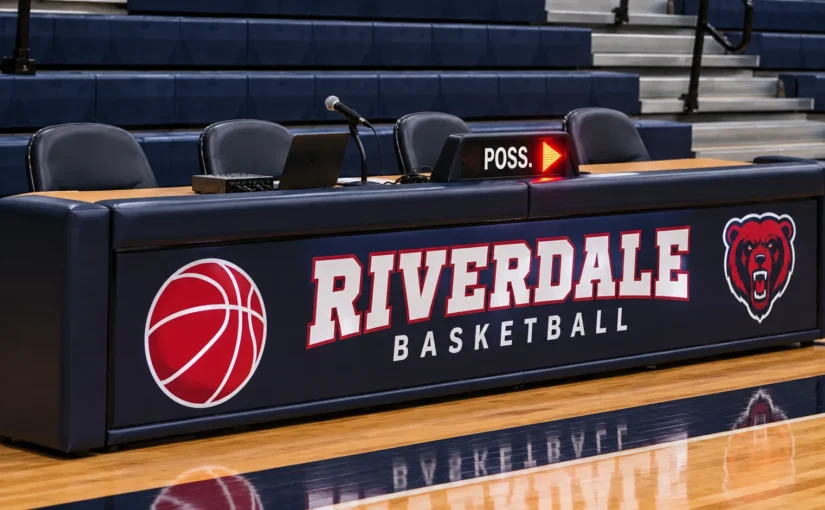
A basketball scorer’s table sits near the sideline, usually around midcourt. It provides space for the official scorer, game timer, and other personnel.

Depending on the competition, staff may include a shot-clock operator, announcer, or statistician.

The table holds equipment such as scorebooks, controllers, laptops, microphones, and possession indicators.

Unlike a basketball scoreboard, which displays game information to players and fans, the scorers table provides a workspace for the people managing the game.

Types of Basketball Scoring Tables

Standard and Padded Scorers Tables

Standard scoring tables provide a work surface and seating for game personnel.

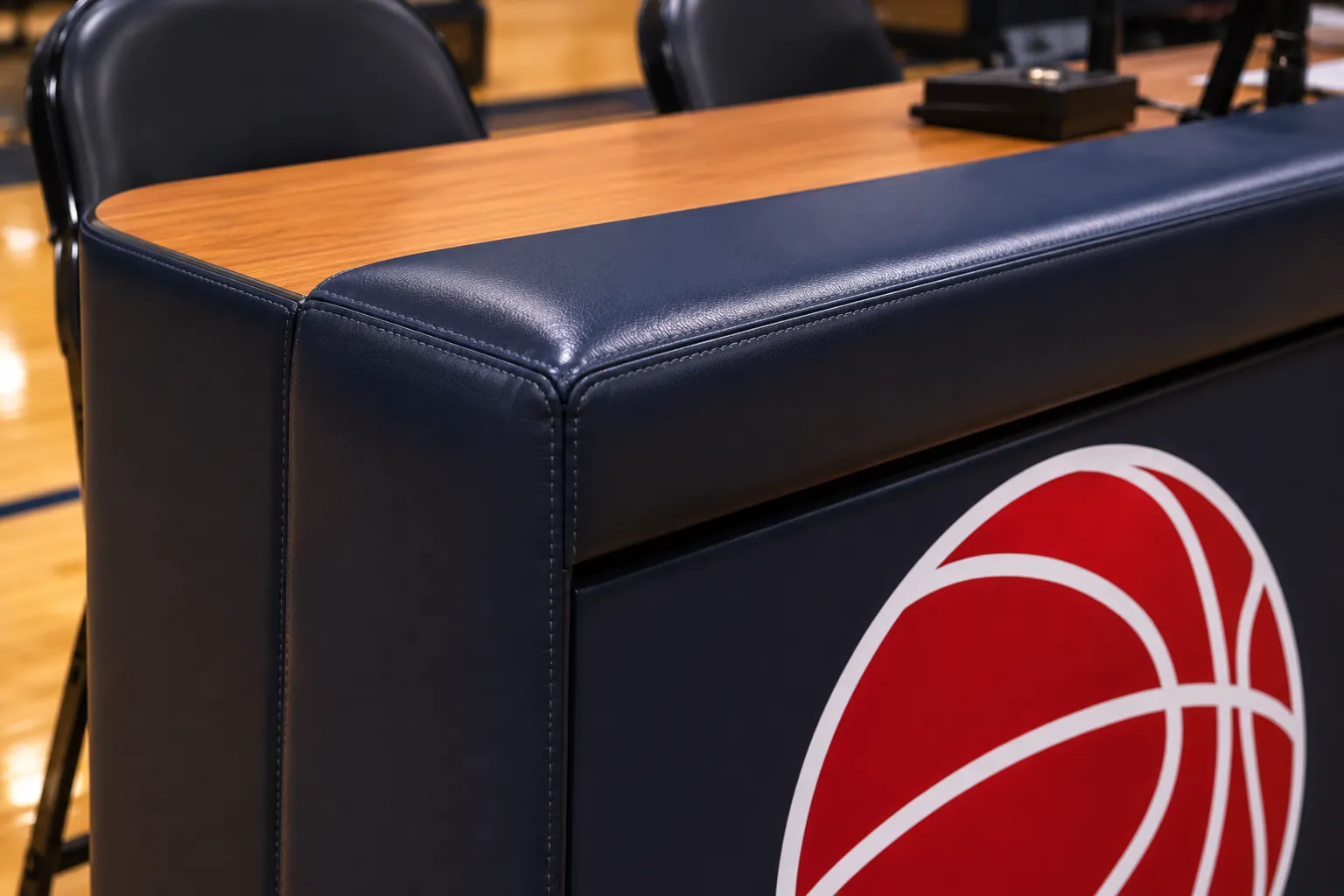
Many models include protective foam padding covered in vinyl. Padding helps reduce the risk of injury if players collide with the table.

The Bison ST84F, for example, has 2-inch front padding and 1-inch side padding.

Close-up of protective padding on a basketball scorers table
Padded edges help reduce injury risks during player collisions.

Folding and Portable Scorers Tables

Before buying, check whether the product will fit through gym doors and into storage. A folding design can make setup easier, but larger tables may still require several people to move safely.

Folding scorers tables suit school gyms and facilities that host multiple indoor sports.

Their worktops or frames fold for easier storage. Some models also include wheels or a transport cart.

Check the folded dimensions and weight before purchasing. Portable does not always mean lightweight.

Illuminated Scorers Tables

Illuminated tables display school logos, team colors, or sponsor graphics using backlit panels.

These models can promote school identity and improve sponsor visibility during games.

However, a backlit graphic is not the same as a programmable video display.

LED Video Scorers Tables

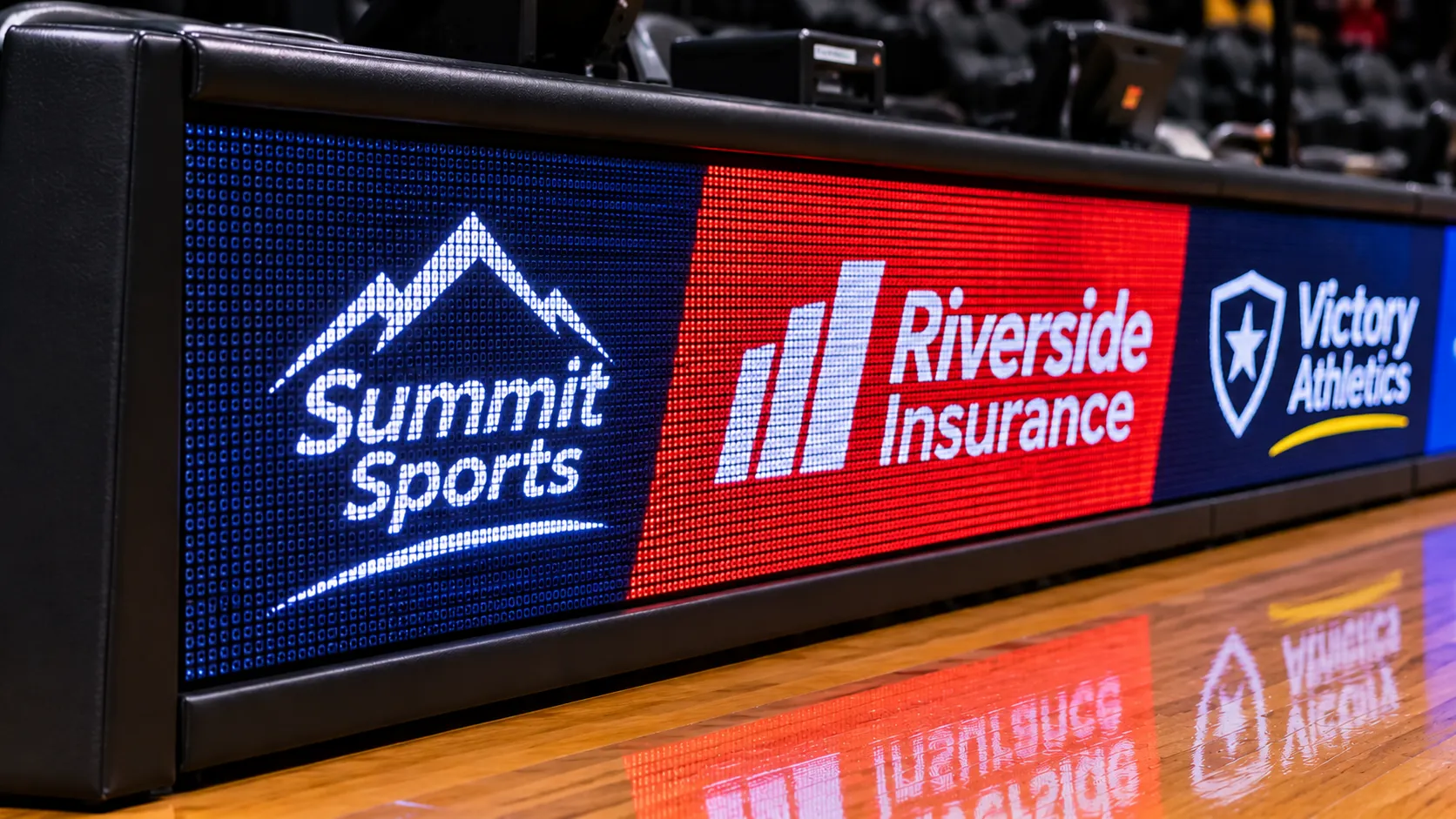
LED scorers tables can rotate multiple sponsor logos, advertisements, and animations during games. Some systems can also display live game information, depending on their features.

LED video scoring tables use digital panels to display animations, sponsor advertisements, and other visual content.

They are common in larger basketball facilities where digital branding and sponsorship revenue are important.

These tables require suitable power, controls, and sometimes additional software.

LED basketball scorers table displaying fictional sponsor advertisements
LED scorers tables can display digital sponsor graphics and advertisements.

Bleacher-Mounted Scorers Tables

Bleacher-mounted tables are designed for facilities with limited sideline space.

They attach to compatible bleacher structures or use manufacturer-approved stabilizers.

They should not be treated as ordinary freestanding tables without checking installation requirements.

Basketball Scorers Table Dimensions

Basketball scorers tables come in different lengths, depths, and heights.

An 8-foot table is a common school gym option, but dimensions vary between manufacturers.

For example:

Model Dimensions or capacity
Bison ST84F 8 ft long × 30 in deep; four seats
Nevco ST-8-NL 8 ft × 3 ft × 34 in
Varsity Video Table 4420 8 ft 3 in long × 3 ft deep × 3 ft 4 in high

Larger tables accommodate additional chairs, laptops, and scoring equipment.

Measure the available floor space, operator seating, and storage route before choosing a size.

How Much Does a Basketball Scorers Table Cost?

Basketball scorers table prices depend on construction, size, padding, graphics, and electronic features.

The following are published US prices researched on November 14, 2026.

Scorers table Listed price
Bison ST84F folding table $2,808 MSRP
Bison Sport Pride Graphic $4,695–$6,986
Bison ST85FI illuminated $6,431
Nevco ST-8-NL Quote required
Varsity Video Table 4420 $15,894.73
BSN Digital Scorers Table $34,999.99

Some models, including the Bison ST84F and ST80LED, were listed as sold out by their manufacturer. Prices may exclude freight, installation, graphics, and other costs.

A basic padded table usually costs less than a customized LED video model.

Basketball Scorers Table Padding and Safety

Protective padding is an important consideration because basketball players may collide with courtside equipment.

Look for padded front panels, protected corners, secure frames, and stable supports.

Tables equipped with wheels should have suitable locking mechanisms.

Keep electrical cables away from playing areas and walkways.

Padding can reduce impact risks, but it cannot guarantee that injuries will not occur.

Where Should a Basketball Scorers Table Be Positioned?

The scorers table is generally positioned along the sideline near the center of the basketball court.

The NBA identifies an 8-foot substitution box in front of the table. This does not mean the table itself must be 8 feet long.

NCAA and NFHS competitions have their own court and game-management requirements.

Check the applicable rules and facility layout rather than assuming one placement distance applies everywhere.

For more information about playing areas and sideline layouts, see our basketball court dimensions guide.

What Equipment Goes on a Scorers Table?

A basketball scoring table may hold:

  • Official basketball scorebook.
  • Game clock and scoreboard controller.
  • Shot-clock controller, where required.
  • Possession arrow.
  • Microphone and communication equipment.
  • Laptop or statistics equipment.

The equipment depends on the competition and the personnel working at the table.

For facilities that need movable scoring displays, see our portable basketball scoreboard guide.

How to Choose a Basketball Scorers Table

Consider these factors before buying:

  1. Size: Allow enough room for chairs, operators, and equipment.
  2. Padding: Check front and side protection.
  3. Storage: Compare folding designs, wheels, and available storage space.
  4. Graphics: Choose plain, customized, illuminated, or LED video panels.
  5. Power: Confirm electrical requirements for illuminated models.
  6. Budget: Include delivery, installation, accessories, and maintenance.

For most small school gyms, a padded folding table is a practical starting point.

Frequently Asked Questions

How many people sit at a basketball scorers table?

It depends on the model. Some 8-foot tables accommodate three or four people, while larger models provide additional seating.

How far should a scorers table be from the court?

There is no single verified distance that applies to every basketball competition. Follow the relevant governing rules and facility safety requirements.

Can basketball scorers tables fold for storage?

Yes. Many portable models have folding worktops or frames. Some also include transport wheels.

Do basketball scorers tables need padding?

Padding is an important safety feature, especially where players could contact the table. Exact requirements depend on the competition and facility.

Can you customize a basketball scorers table?

Yes. Manufacturers offer custom team colors, school logos, sponsor graphics, and illuminated or digital displays.

Final Thoughts

A basketball scorers table should provide enough workspace for game personnel while maintaining safe courtside conditions.

For smaller gyms, padded folding tables offer useful storage and flexibility. Larger facilities may benefit from customized or LED video tables.

Compare dimensions, features, manufacturer specifications, and total costs before purchasing.

Portable Basketball Scoreboard | Types, Features & Costs

A portable basketball scoreboard displays game scores and, depending on the model, the clock, period, possession, and bonus indicators. Unlike permanent basketball scoreboards, portable models can move between courts or into storage.

They suit school gyms, youth leagues, recreational games, and temporary venues. The right choice depends on visibility, available power, required features, and budget.

Types of Portable Basketball Scoreboards

Electronic LED Scoreboards

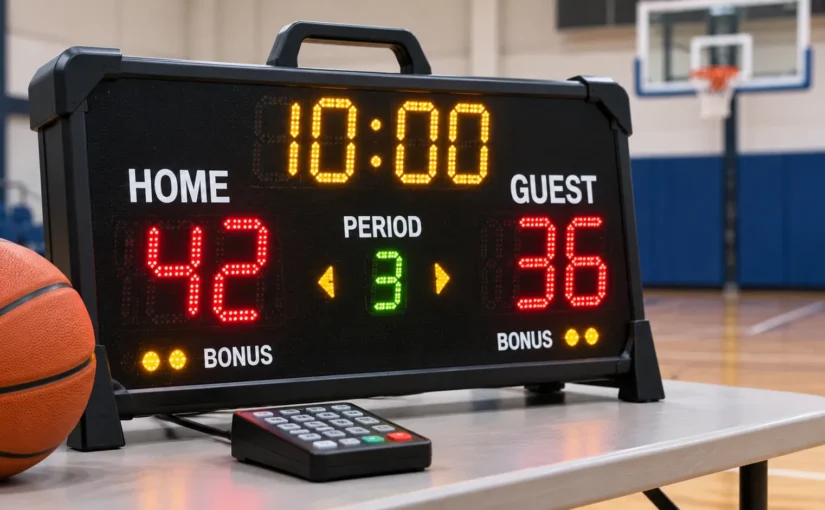
LED basketball scoreboards use illuminated digits to show scores and game information. Many include a clock, buzzer, and handheld controller.

The Varsity LED-4 is a compact tabletop model designed for basketball and other indoor sports, including volleyball and wrestling.

LCD Basketball Scoreboards

LCD scoreboards use liquid crystal displays instead of illuminated LED digits.

The Ultrak T-300 has 4-inch LCD digits and operates using an AC adapter or four D batteries. Its battery option makes it useful where power outlets are limited.

Manual Flip Scoreboards

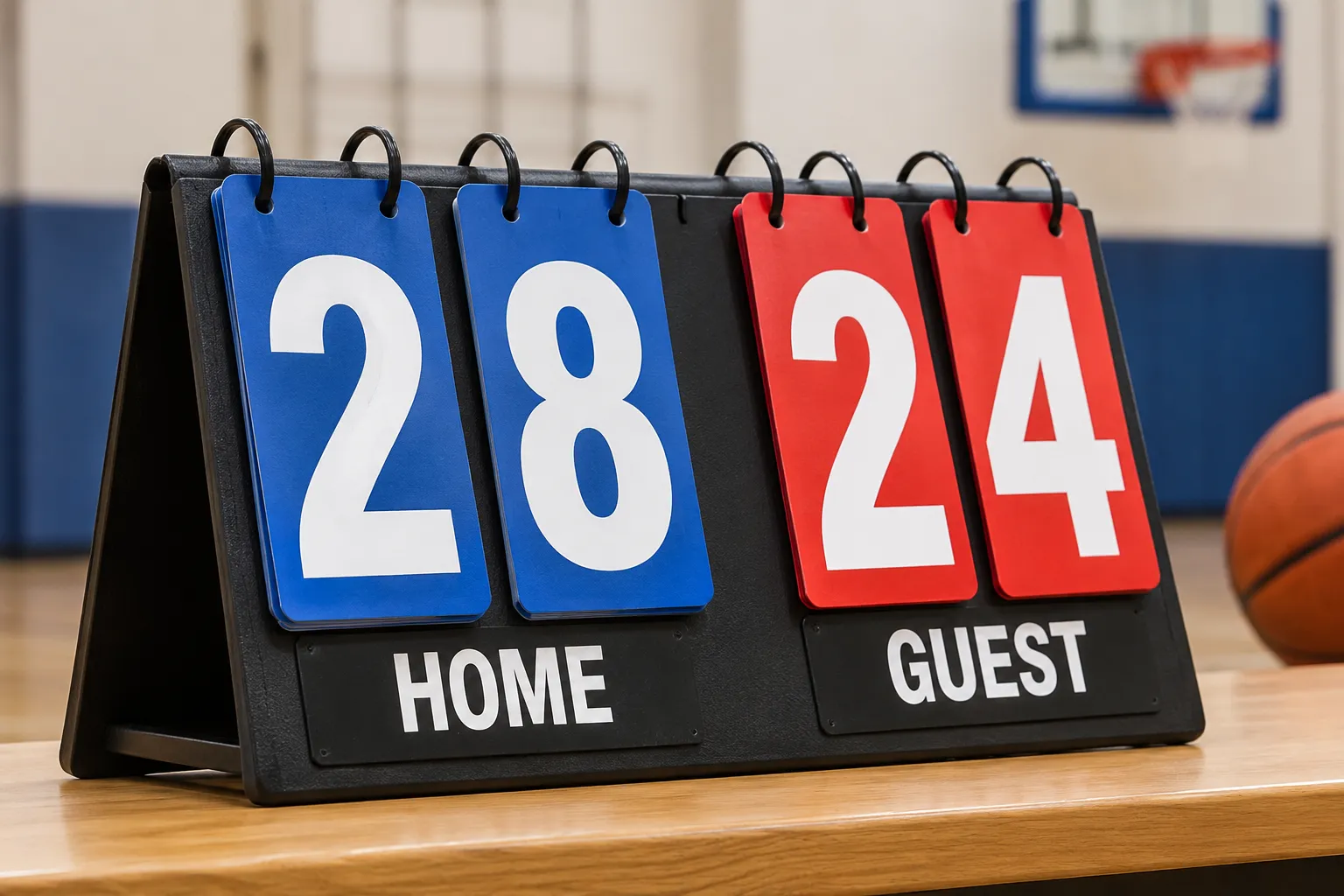
Manual scoreboards use numbered cards that an operator flips to update the score.

They are lightweight, inexpensive, and require no electricity. However, they lack an automatic game clock and horn.

Portable manual flip basketball scoreboard showing home score 28 and guest score 24
Manual flip scoreboard used to track basketball scores without electricity.

Freestanding and Mobile Scoreboards

Larger portable scoreboards can use stands, tripods, or wheels.

These models suit facilities that need to move equipment between courts. Check their dimensions, weight, and stand stability before purchasing.

How Much Does a Portable Basketball Scoreboard Cost?

Portable basketball scoreboards range from under $100 for basic manual models to over $2,000 for larger electronic units.

Portable Basketball Scoreboard Price Comparison

Scoreboard Listed price
Champion Sports FAS4 $77.09 MSRP
Varsity LED-4 $380
Ultrak T-300 $755
Champion Sports T90/T90R $930.84–$1,053.59
ScoreTronics PCK-4 $1,650
Seiko KT-601 $1,795
First Team FT810W $2,193–$2,397

Prices are from research dated November 14, 2026. Availability, shipping, accessories, and final costs may differ. The Champion FAS4 was listed out of stock by its manufacturer.

The Varsity LED-4 offers an entry-level electronic option, while larger models provide different display sizes and mounting choices.

What Features Should You Look For?

A portable electronic basketball scoreboard should meet the needs of the games being played.

Important features include:

  • Score display: Home and guest team points.
  • Game clock: Countdown or count-up timing.
  • Period indicators: Current quarter or half.
  • Bonus and possession indicators: Useful game information.
  • Horn: Audible signals.
  • Controller: Convenient score and clock adjustments.

Some scoreboards also display team fouls and timeouts. Check the specifications because a bonus indicator does not necessarily display the number of team fouls.

Battery-Powered vs Plug-In Scoreboards

Battery-powered scoreboards offer flexibility when outlets are unavailable.

The ScoreTronics PCK-4 uses AA batteries, while the Ultrak T-300 accepts D batteries or an AC adapter.

Plug-in models need a suitable power supply. A wireless handheld controller does not mean the scoreboard itself operates without a power cord.

Do Portable Basketball Scoreboards Include Shot Clocks?

Most basic portable basketball scoreboards do not include a complete regulation shot-clock system.

NBA games use a 24-second shot clock, while NCAA basketball uses a 30-second shot clock. High school associations may adopt a 35-second shot clock.

Facilities hosting official games must confirm their league’s equipment requirements. A portable game clock alone may not be sufficient.

Choosing a Portable Basketball Scoreboard for Indoor Sports

Schools and Youth Leagues

Choose an electronic model with clear digits, a reliable game clock, and simple controls.

Recreation Centers and Gyms

A multisport scoreboard can serve basketball, volleyball, wrestling, and other indoor sports.

Home Basketball Games

A manual flip scoreboard is often enough for informal games. Electronic models add timing and audible signals.

How to Set Up a Portable Basketball Scoreboard

  1. Place the scoreboard where players and fans can see it.
  2. Keep stands and electrical cables outside playing areas.
  3. Check the power supply and handheld controller.
  4. Test the clock, score buttons, and horn.
  5. Confirm the display is readable from the farthest seats.

For outdoor use, check the manufacturer’s weather-resistance specifications.

Common Buying Mistakes

Avoid buying a scoreboard without checking its power requirements, display visibility, and game functions.

Also consider shipping costs, optional stands, storage space, and replacement parts. Larger electronic scoreboards may require additional equipment.

Frequently Asked Questions

Can a portable basketball scoreboard run on batteries?

Yes. Some models use replaceable batteries, while others require AC power.

Can portable scoreboards be used outdoors?

Only when the manufacturer confirms suitable outdoor operation. Weather resistance varies between models.

Can one scoreboard work for multiple sports?

Yes. Many electronic models support basketball, volleyball, wrestling, and other sports.

Are portable scoreboards suitable for high school games?

They can be, but the scoreboard and any required shot-clock equipment must meet the relevant competition rules.

Final Thoughts

The best portable basketball scoreboard depends on the venue, budget, and game requirements.

For small indoor gyms, a tabletop electronic model offers a practical balance of features and portability. For informal home games, a manual scoreboard may be sufficient. Larger facilities should prioritize visibility, reliable controls, and equipment compatibility.

Basketball Scoreboard | Types, Features, Prices & Buying Guide

A basketball scoreboard displays the score, game clock, and period during a basketball game. Many models also show team fouls, timeouts, possession, and bonus indicators.

For schools, gyms, and recreation centers, choosing the right scoreboard means comparing display size, features, installation requirements, and total cost.

This guide covers fixed basketball scoreboards, including indoor, outdoor, and professional systems.

Types of Basketball Scoreboards

LED Basketball Scoreboards

An LED basketball scoreboard uses illuminated digits to display game information. These displays are common in schools, sports facilities, and indoor basketball courts.

LED scoreboards can show scores, periods, fouls, and other information. Available features depend on the model.

Digital and Electronic Scoreboards

Digital, electronic, and LED scoreboards are not necessarily different products.

Most modern electronic basketball scoreboards use LED technology. The word digital can describe either a standard numeric display or a more advanced video screen.

For schools and gyms that need a movable option, see our portable basketball scoreboard guide for types, features, and prices.

Video Basketball Scoreboards

Video scoreboards use large screens to display scores, team logos, player statistics, advertisements, and video content.

They are commonly associated with larger sports venues. Their equipment and installation requirements can be considerably more complex than those of standard numeric scoreboards.

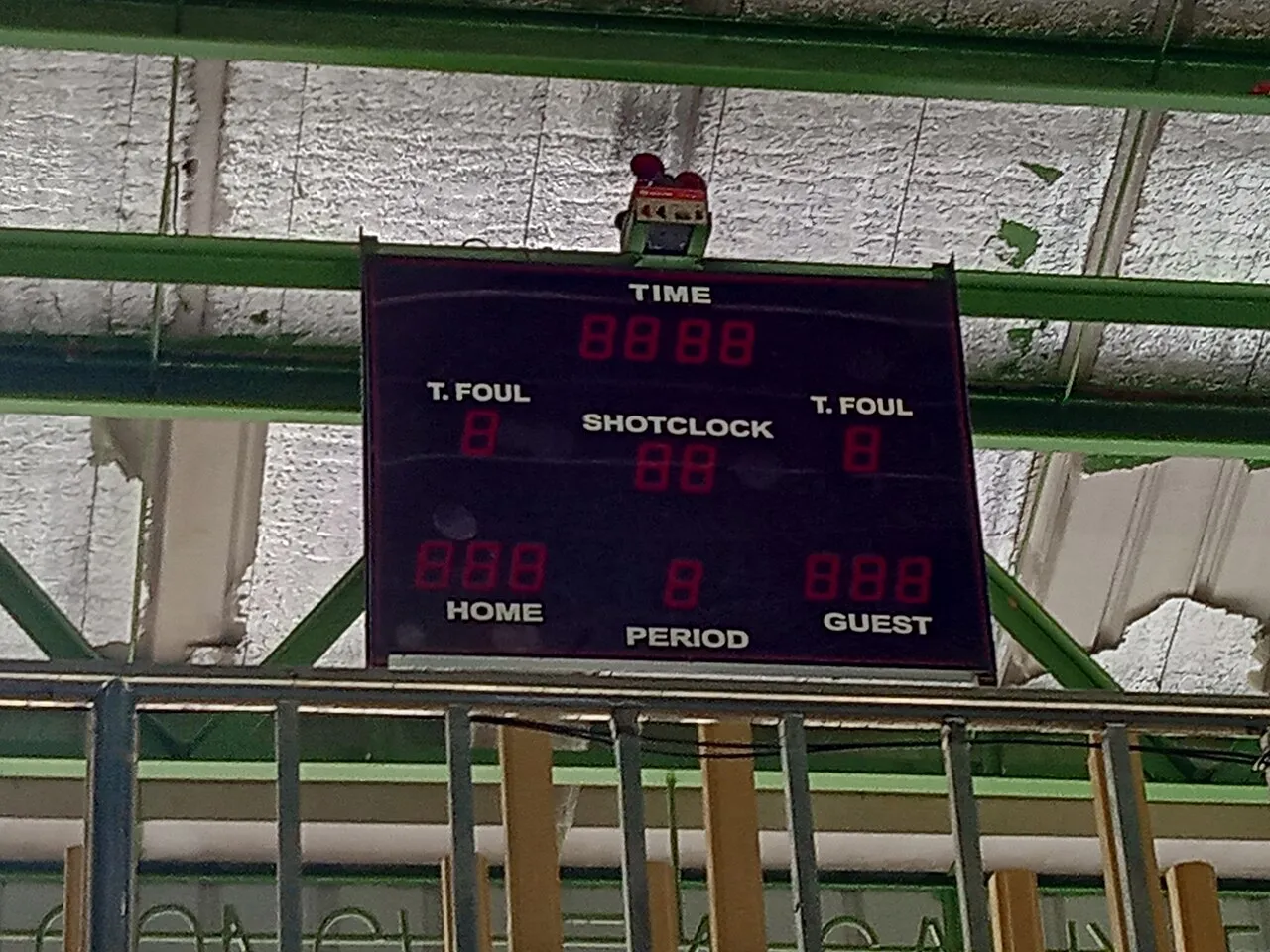
Electronic basketball scoreboard displaying scores and game time inside a school gymnasium.
Indoor basketball scoreboard at Pasay City West High School.

Photo by JustinLRT, via Wikimedia Commons. Licensed under CC BY-SA 4.0. Resized and converted to WebP.

Indoor vs Outdoor Basketball Scoreboards

Indoor scoreboards are designed for gyms and enclosed sports facilities. Outdoor models must withstand environmental conditions.

Feature Indoor scoreboard Outdoor scoreboard
Location Gym or arena Outdoor basketball court
Weather protection Not necessarily weather-rated Designed for outdoor exposure
Visibility Indoor lighting Sunlight and outdoor lighting
Installation Wall or overhead structure Weather-appropriate mounting

Choose a scoreboard specifically approved by its manufacturer for the intended environment.

What Does a Basketball Scoreboard Display?

A basketball scoreboard can include several scoring and timing features:

  • Score counter: Shows each team’s points.
  • Game clock: Displays the time remaining.
  • Period: Identifies the current quarter or half.
  • Team fouls: Tracks fouls against each team.
  • Bonus indicators: Show when a team has reached the foul limit for free-throw penalties. The rules differ between the NBA, NCAA, and high school basketball. Some scoreboards also display a double-bonus indicator.
  • Possession indicator: Shows which team receives the ball at the next alternating-possession opportunity. This applies to competitions using alternating-possession rules, such as NCAA and high school basketball.
  • Timeouts: Shows remaining team timeouts.
  • Player statistics: Available on advanced models.
  • Team names, logos, and colors: Some scoreboards offer customizable team names, logos, and display colors. These options depend on the model and may cost extra.

A shot clock may be separate from the main scoreboard. Check whether compatible shot clocks are included before purchasing.

How Much Does a Basketball Scoreboard Cost?

Basketball scoreboard prices vary by size, manufacturer, features, and configuration.

The following are manufacturer-listed examples researched on November 14, 2026.

Basketball scoreboard Listed price
Daktronics BB-2101 Starting at $5,290
Daktronics BB-2103 Starting at $7,440

Source: Daktronics basketball scoreboard catalog.

Nevco also provides an estimated price range of $3,500–$14,000 for indoor basketball scoreboards in its scoreboard cost guide.

These figures are not complete installation quotes.

Basketball Scoreboard Installation Costs

Installation expenses depend on the mounting location, electrical requirements, structural support, and equipment access.

A full project may require brackets, wiring, lift equipment, professional installation, and testing.

Request an itemized quote rather than relying on the scoreboard’s purchase price alone.

Additional Equipment Costs

Shot clocks, controllers, backboard lights, and other accessories can increase the total cost.

For example, Daktronics listed several shot-clock packages starting at $3,125 when researched.

Check which accessories are included and which must be purchased separately.

Basketball Scoreboard Manufacturers

Several established manufacturers supply fixed basketball scoreboards.

Daktronics

Daktronics offers electronic scoreboards, controllers, shot clocks, and video display systems.

Its BB-2101 scoreboard measures 8 feet wide and 4 feet high.

Nevco

Nevco supplies indoor basketball scoreboards, wireless controllers, and center-hung displays.

Its Model 2700 is an indoor scoreboard measuring 8 feet wide and 3 feet high.

Fair-Play

Fair-Play offers basketball scoreboards with different display layouts, player-stat panels, and control systems.

Electro-Mech

Electro-Mech manufactures indoor and outdoor basketball scoreboards.

Its LX7260 is an outdoor model measuring 9 feet wide and 5 feet high.

How to Choose a Basketball Scoreboard

The best basketball scoreboard depends on the facility and competition requirements.

Consider these factors before purchasing:

  1. Display size and viewing angles: Choose digits large enough for players, coaches, and spectators to read from different positions. Check visibility from the farthest seats and both ends of the court. Avoid locations where beams, banners, or lighting obstruct the display.
  2. Game features: Check scores, fouls, timeouts, possession, and shot-clock compatibility.
  3. Control system: Basketball scoreboards are typically operated using a controller at the scorer’s table. Compare wired, wireless, and app-based controls. Check compatibility, ease of use, and connection reliability.
  4. Competition rules: Confirm the correct timing and scoring requirements.
  5. Total cost: Include installation, accessories, maintenance, and support.

The controller is usually operated from a courtside workstation. Our basketball scorers table guide covers table types, dimensions, prices, and safety features.

For a typical school gym, a fixed numeric LED scoreboard is often a practical starting point.

If you’re planning a new facility, our basketball court dimensions guide explains how court sizes differ between competitions.

Basketball Scoreboard Rules

Different basketball organizations use different shot-clock rules.

Competition Shot clock
NBA 24 seconds
NCAA men’s and women’s 30 seconds
NFHS high school 35 seconds where adopted

The NBA also uses shorter shot-clock resets in certain situations.

NFHS allows state associations to adopt shot clocks. Therefore, not every US high school requires one.

Check the relevant competition rules before purchasing equipment.

Sources: NBA, NCAA, and NFHS.

Basketball Scoreboard Installation

Fixed basketball scoreboards are commonly wall-mounted or suspended from overhead structures.

Wall-mounted systems require suitable structural support and clear viewing angles.

Center-hung scoreboards can be substantially heavier and require professional structural planning.

A qualified installer should assess mounting, electrical connections, and safe access before installation.

For wider facility projects, our basketball court installation guide explains the construction process and what to check when hiring an installer.

Basketball Scoreboard Maintenance

Regular maintenance helps keep the scoreboard operating correctly.

Check the display, power connections, controller, and timing equipment according to the manufacturer’s instructions.

Wireless systems can experience interference or connection problems. A compatible wired backup may help prevent interruptions.

Frequently Asked Questions

Are LED and digital basketball scoreboards the same?

Often, yes. Many digital scoreboards use LED digits. However, digital can also describe advanced video displays.

Can basketball scoreboards work for multiple sports?

Yes. Many electronic scoreboards support basketball, volleyball, and other sports through compatible controls.

Can you control a basketball scoreboard with a phone?

Some models support mobile control. For example, compatible Daktronics scoreboards can use the All Sport Lite app (formerly DAK Score).

Does every basketball scoreboard include a shot clock?

No. Shot clocks are often separate equipment and may require compatible controllers.

Final Thoughts

A basketball scoreboard should provide clear scoring information, reliable timing, and the features required for its intended competition.

Compare manufacturers, verify compatibility, and obtain complete installation quotes before purchasing.

Featured image: Photo by Sullymaan, via Wikimedia Commons. Licensed under CC BY-SA 4.0. Resized and converted to WebP.

Basketball Court Cleaner | Products, Methods & Costs

The best basketball court cleaner depends on the type of playing surface. Hardwood courts need an approved floor cleaner, a dust mop, and very little moisture. Synthetic courts may allow damp mopping or automatic scrubbers, while outdoor courts often need sweeping and controlled washing.

Using the wrong cleaning solution or equipment can damage the floor, leave slippery residue, or affect its playing surface.

This guide explains which basketball court cleaning products to use, how to clean different surfaces, and what the equipment costs.

What Is the Best Basketball Court Cleaner?

There is no single cleaner suitable for every basketball court.

A finished hardwood gym floor needs different care from a vinyl, rubber, or outdoor acrylic surface. Before buying cleaning supplies, identify the floor material and check its manufacturer’s maintenance instructions.

Basketball court surface Suitable cleaning method Main precaution
Hardwood Dust mop and approved low-moisture cleaner Avoid wet mopping and power scrubbers
Vinyl sports flooring Dust mop and approved detergent Follow the specific pad and rinsing instructions
Rubber sports flooring Untreated dust mop and compatible cleaner Avoid abrasive brushes and unapproved solvents
Poured polyurethane Approved cleaner and permitted scrubber Check the installed floor system
Outdoor acrylic Broom, soft brush, and controlled rinsing Avoid aggressive pressure washing
Modular sports tiles Broom, dust mop, or approved washing method Check drainage and debris beneath the tiles

The Maple Flooring Manufacturers Association (MFMA) recommends daily dust mopping for maple sports floors and warns against water-using power scrubbers.

Synthetic flooring manufacturers may permit machines, but their instructions differ.

Types of Basketball Court Cleaning Products

Basketball court maintenance involves several tools. Some remove dust, while others remove marks, spills, or built-up dirt.

Basketball Court Floor Cleaners

Liquid floor cleaners remove dirt that dry mopping cannot collect.

Bona SuperCourt Cleaner Concentrate is designed for unwaxed polyurethane wood floors. Bona specifies a dilution of one part concentrate to 128 parts water.

Hillyard Top Clean is a neutral floor cleaner listed among the maintenance options in Tarkett’s Omnisports guidance.

Neither product should be treated as suitable for every basketball court. Always confirm that the cleaner is approved for the installed floor and finish.

Dust Mops, Damp Mop, and Microfiber Systems

A dust mop is one of the most important tools for indoor basketball court cleaning.

Wide microfiber dust mops collect loose dirt, dust, and grit before these particles scratch the playing surface.

For large gyms, a 60-inch dust mop can cover more floor with each pass than a small household mop.

Some systems also include separate pads for damp cleaning.

Use the dust mop treatment recommended for the floor. Oil-treated mops, for example, are prohibited in Tarkett’s Omnisports maintenance guidance.

Basketball Court Cleaning Machines

An auto scrubber uses a rotating pad or brush to clean the floor and recover dirty cleaning solution.

These machines can make cleaning large synthetic courts easier, provided the flooring manufacturer approves their use.

However, they are not suitable for every gym.

MFMA advises against automated power scrubbers for routine maple floor maintenance because of moisture, equipment weight, and potential floor damage.

Before using a machine, check its loaded weight, pad type, operating speed, water recovery, and floor compatibility.

Outdoor Court Cleaning Equipment

Outdoor basketball courts often need simpler equipment:

  • Soft-bristled brooms
  • Leaf blowers
  • Garden hoses
  • Approved cleaning solutions
  • Pressure washers, where permitted

Avoid assuming that a pressure washer is safe because the court is made from asphalt or concrete. Its acrylic coating may have separate cleaning restrictions.

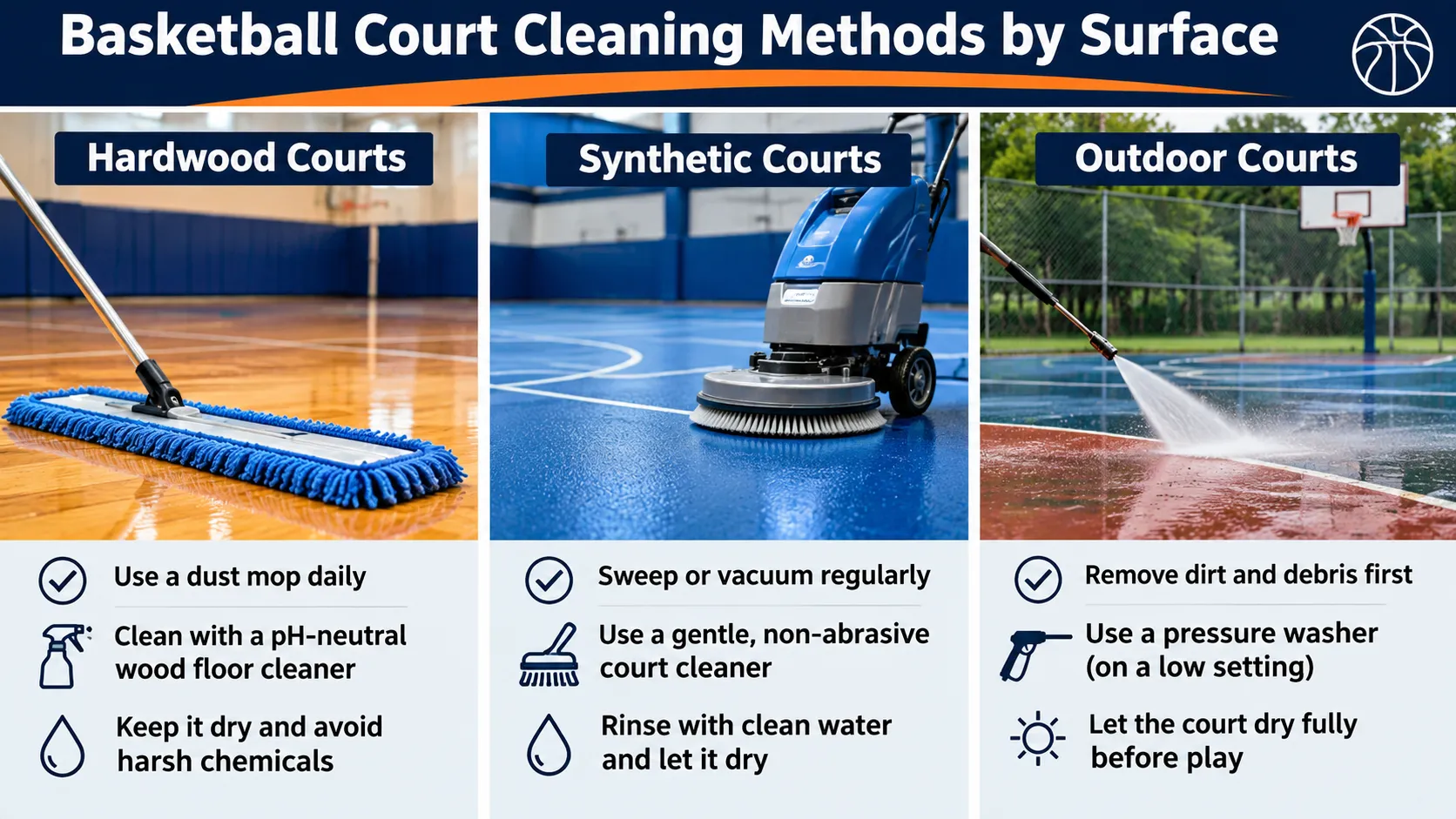
Basketball court cleaning methods for hardwood, synthetic, and outdoor surfaces
Cleaning methods vary by court surface. Only pressure wash where the flooring manufacturer permits it.

How to Properly Clean a Basketball Court

The correct process starts with identifying the playing surface. If you are planning a new court, our basketball court installation guide explains the broader installation process.

How to Clean a Hardwood Basketball Court or Gym Floor

Indoor hardwood courts require delicate handling to preserve the finish.

  1. Remove loose dirt using a properly treated dust mop.
  2. Wipe up sweat, spills, and other moisture immediately so they do not soak in; this helps maintain a clean court, supports safety, and reduces the risk of slips for athletes.
  3. Remove shoe marks with a finish-approved cleaner and soft cloth.
  4. For more thorough cleaning, use the manufacturer’s approved low-moisture method.
  5. Inspect the floor for remaining moisture or residue before allowing play.

MFMA describes a controlled method using a fine mist of approved cleaner and a microfiber T-frame mop. The solution is wiped up immediately rather than left soaking on the floor. Proper cleaning helps protect the finish and preserve durability. If dirt and moisture are left in place, they can break down the surface over time and lead to cracks and discoloration that shorten the floor’s life and extend repair needs.

Do not use a wet mop, bucket flooding, or routine power scrubbing on maple sports floors.

These methods can introduce excess moisture and damage the wood or finish, undermining a safe playing environment.

How to Clean a Synthetic Basketball Court

Synthetic basketball courts include vinyl, rubber, and poured polyurethane flooring.

Their cleaning requirements vary, and proper cleaning helps protect the surface, support durability, and preserve safety and performance.

For example, Gerflor’s sports sheetgoods guidance allows approved machine cleaning with controlled solution application, recovery, and rinsing.

Tarkett Omnisports specifies neutral detergent and a white nylon pad for routine machine washing.

Robbins Pulastic flooring has its own cleaning solution and machine instructions.

A basic process is:

  1. Remove dust and debris daily to help create a safe playing environment for athletes.
  2. Prepare the manufacturer-approved cleaning solution.
  3. Use the permitted mop or cleaning machine.
  4. Recover dirty water and rinse where required.
  5. Allow the floor to dry before reopening, since the wrong machine setup can increase the risk of floor damage rather than make the job easier.

Never copy a machine pad, chemical dilution, or cleaning procedure from another synthetic flooring brand without checking compatibility.

How to Clean an Outdoor Basketball Court

Outdoor courts collect leaves, sand, dirt, and standing water, so regular cleaning helps protect the surface from moisture and grit that can gradually break it down.

For an acrylic-coated court:

  1. Sweep away loose debris.
  2. Remove leaves and other material that traps moisture.
  3. Clean dirty areas with the coating manufacturer’s approved solution.
  4. Use a soft brush where permitted.
  5. Rinse according to the manufacturer’s instructions to help extend the court’s life and maintain playability.
  6. Let the surface dry completely before playing.

Pressure washing requires particular care.

DecoTurf’s maintenance guidance permits pressure washing below 1,000 psi. Other manufacturers provide different instructions or warn against excessive pressure.

Do not treat 1,000 psi as a universal safe setting. Check the exact court coating first.

How to Clean Modular Basketball Court Tiles

Modular basketball courts often use interlocking plastic sports tiles.

Sport Court recommends regular dust mopping for indoor surfaces and permits brooms, blowers, or hoses for outdoor game courts.

Outdoor tiles may also collect debris underneath their playing surface.

Sport Court recommends annual inspection and cleaning by its CourtBuilder network, including the area beneath the tiles.

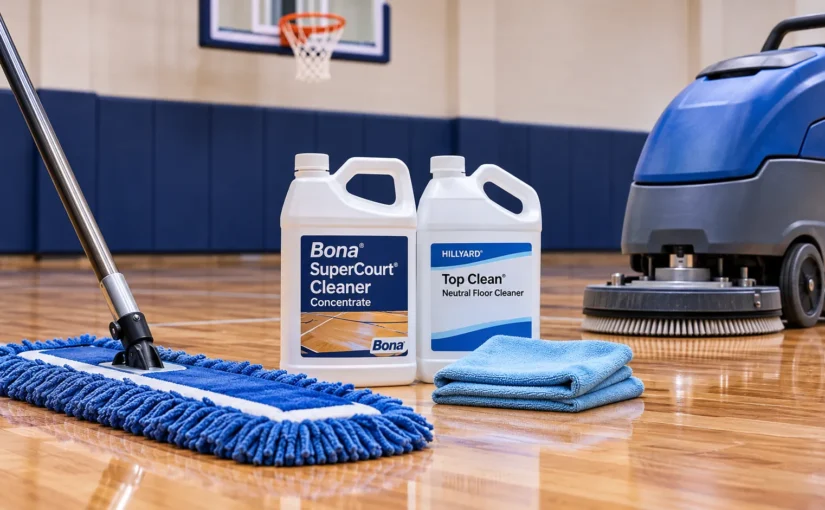
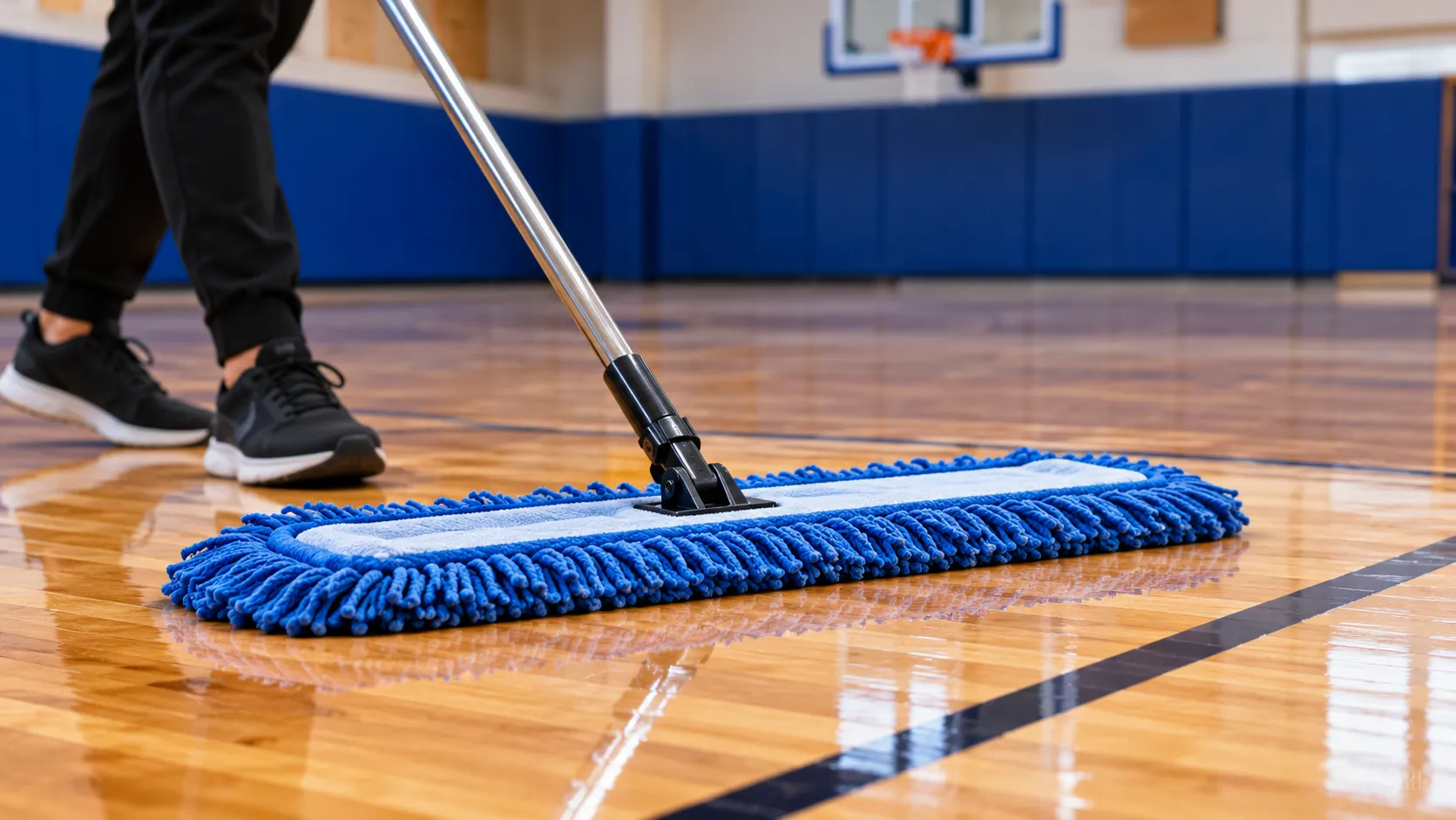
Blue microfiber dust mop cleaning a hardwood basketball court
Dust mopping helps remove dirt and grit from hardwood basketball courts.

Basketball Court Cleaner Products and Prices

The following examples show the range of basketball court cleaning supplies available in the United States.

Prices are research observations from November 14, 2026. They may change.

Product Approximate price Main use
Bona SuperCourt Cleaner Concentrate, 1 gallon $74 Compatible polyurethane wood finishes
Hillyard Top Clean, 1 gallon $34 Compatible synthetic flooring
Bona SuperCourt Athletic Floor Care System, 60-inch $208 Manual dusting and damp cleaning
CourtClean Damp Mop System $999 Wide manual damp-cleaning system
Viper AS5160 Walk-Behind Scrubber $6,067 Approved machine-cleanable surfaces

These products serve different purposes, so the cheapest item is not necessarily the best choice.

A floor cleaner needs a suitable mop or application system. A scrubber requires floor approval and ongoing equipment maintenance.

The Viper machine is included as a price example, not as a recommendation for hardwood courts.

How Often Should You Clean a Basketball Court?

Cleaning frequency depends on court traffic, floor material, and the manufacturer’s instructions.

Daily Cleaning

Busy indoor courts generally need daily dust removal because cleaning each day removes dust that settles overnight.

MFMA recommends dust mopping maple basketball courts daily, or up to three times daily during heavy use, to remove dust and dirt.

Sweat and spills should be removed immediately.

A school may also need additional cleaning between physical education classes, practices, and games.

Weekly Maintenance

Inspect the floor for dirt, residue, shoe marks, and areas needing additional attention.

Some synthetic surfaces permit weekly machine cleaning. Others specify different intervals.

Do not introduce weekly wet mopping to hardwood courts simply because it is part of a general gym cleaning schedule.

Periodic Deep Cleaning

Deep cleaning removes dirt that routine maintenance cannot address.

Gerflor’s January 2026 sports sheetgoods guidance describes regular machine cleaning every two weeks and deeper cleaning every two to three months.

Robbins recommends monthly whole-floor cleaning with an approved cleaner for its hardwood systems.

Hardwood screening and recoating are separate maintenance operations. MFMA says most gym floors should be recoated annually, depending on use and condition.

How Much Does Basketball Court Cleaning Cost?

Basketball court cleaning costs depend on the surface, equipment, cleaning frequency, and labor.

Cleaning Solution Costs

Concentrated products can provide many gallons of diluted cleaning solution.

For example, a $73.58 gallon of Bona SuperCourt concentrate, budgeted at one fluid ounce per gallon of water, costs approximately $0.57 in concentrate per gallon of dilution water.

At $34 per gallon, Hillyard Top Clean costs approximately $0.27–$0.80 per gallon of dilution water when using one to three fluid ounces.

These figures exclude water, equipment, labor, and other expenses.

They also do not indicate how much liquid should be applied to a particular court.

Equipment and Labor Costs

For a large-floor maintenance job, manual cleaning systems may cost a few hundred dollars, while commercial scrubbers can cost several thousand.

Labor can be a larger expense than cleaning chemicals, and while machines may seem to make the job easier, equipment choice still depends on floor approval and damage risk.

For example, assume a worker spends 30 minutes cleaning once per week at a total labor cost of $25 per hour.

That equals $650 annually in labor.

This is an illustrative calculation, not a verified industry rate or recommended cleaning schedule.

Professional Basketball Court Cleaning

Professional cleaning prices vary with court size, floor condition, location, and the required procedure.

Ask contractors for an itemized quote that identifies the floor material, approved cleaning products, equipment, and any additional services.

Do not confuse routine cleaning costs with hardwood refinishing or outdoor court resurfacing. Our basketball court installation guide covers wider project costs.

Basketball Court Cleaning Mistakes to Avoid

Even regular cleaning can cause problems when the wrong products or methods are used.

Using excess water: Hardwood can absorb moisture, potentially causing swelling, cupping, or other damage.

Using household cleaning chemicals: Unapproved cleaners can damage finishes or leave residue. MFMA specifically warns against household products on maple floors.

Using the wrong scrubber pad: Different synthetic floors require different pads and brushes. An abrasive pad can damage the surface.

Adding too much cleaning solution: Stronger mixtures are not automatically better. Incorrect dilution or poor rinsing can leave residue.

Pressure washing too aggressively: High pressure can damage outdoor acrylic coatings and remove surface texture.

Ignoring equipment maintenance: Dirty scrubber tanks, worn pads, and damaged squeegees can reduce cleaning performance.

Always follow the floor manufacturer’s instructions rather than relying on a general cleaning tip.

Frequently Asked Questions

What Does the NBA Use to Clean Basketball Courts?

NBA arenas commonly use courtside mops or absorbent tools to soak up sweat during games before the surface gets slippery.

Routine hardwood floor cleaning is a separate task. The appropriate cleaners and equipment depend on the arena’s floor finish and maintenance instructions.

There is no verified single cleaning product used by every NBA arena.

Can You Mop a Basketball Court With Water?

It depends on the surface.

MFMA advises against wet mopping maple basketball courts. Some synthetic sports floors allow damp mopping or controlled machine washing.

Always follow the installed floor’s maintenance instructions.

Does Cleaning a Basketball Court Improve Grip?

Removing dust, dirt, moisture, and cleaning residue can help maintain the floor’s intended playing characteristics.

However, cleaning cannot guarantee improved traction when the finish is worn or damaged.

No specific grip improvement percentage is established for the products discussed here.

Can You Use Vinegar or Bleach on a Basketball Court?

Do not use vinegar or bleach as general basketball court cleaners.

Some outdoor acrylic manufacturers describe specific bleach treatments, but their instructions differ.

Never transfer those methods to hardwood or synthetic courts without approval. Never mix bleach with other cleaning products.

Can You Use an Auto Scrubber on a Hardwood Basketball Court?

MFMA does not recommend automatic power scrubbers for routine maple court maintenance.

Their weight and water use may damage the floor and affect warranties.

Use the approved manual cleaning method instead.

Final Thoughts

The right basketball court cleaner depends on the floor material, finish, and maintenance requirements.

For hardwood, start with a suitable dust mop and an approved low-moisture cleaner. Synthetic courts may allow automatic scrubbers, while outdoor courts need equipment compatible with their surface coating.

The safest approach is to identify the floor, follow its manufacturer’s cleaning instructions, and remove dirt and spills before they cause further problems.

Basketball Gym Floor Covering | Types, Costs & Protection

A basketball gym floor covering protects an existing court during non-athletic events such as graduation ceremonies, assemblies, concerts, and trade shows.

The main options are reinforced vinyl rolls, carpet rolls, and large protective carpet tiles. Each offers different levels of convenience, durability, and protection.

For most schools and recreation centers, the right choice depends on event frequency, floor material, budget, and available storage space.

This guide compares gym floor covers, explains US costs, and shows how to protect your basketball court without damaging its playing surface.

What Is a Basketball Gym Floor Covering?

A basketball gym floor covering is a temporary protective layer placed over an existing hardwood or synthetic gymnasium floor.

It helps reduce scuff marks, scratches, and everyday wear from heavy foot traffic, tables, and chairs during non-athletic events.

Unlike permanent basketball flooring, protective gym floor coverings are removed before sports resume.

Important: Temporary event covers are generally not designed for basketball play. Remove them before athletic activities unless the manufacturer specifically approves the covering for that use.

The Maple Flooring Manufacturers Association (MFMA) explains that covers provide additional protection for multipurpose hardwood courts, although they aren’t necessary for every event.

Types of Basketball Gym Floor Covering

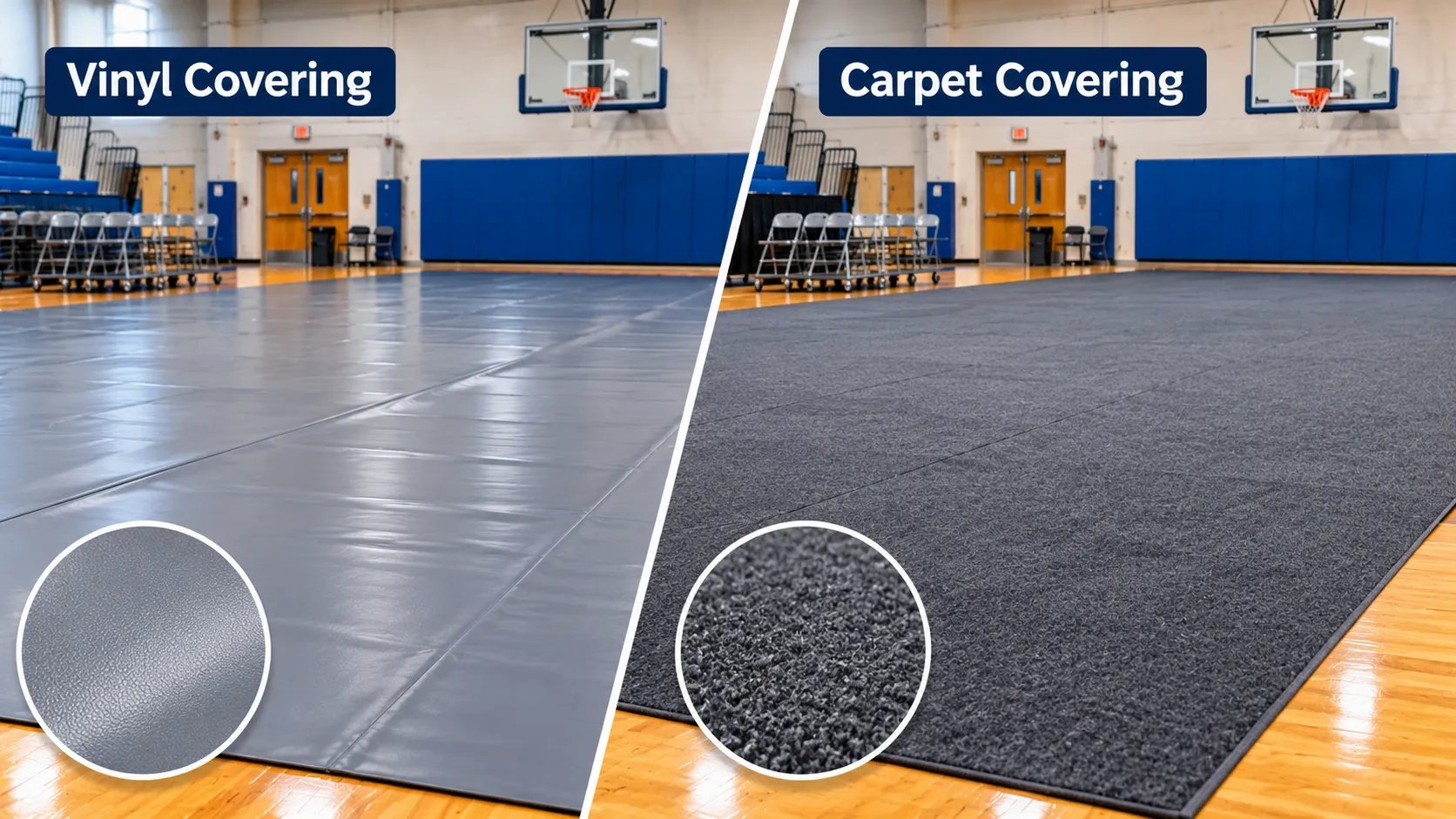
The three main systems are vinyl gym floor covers, carpet rolls, and loose-laid carpet tiles.

Covering Type Best Suited For Main Consideration
Reinforced vinyl rolls Schools hosting regular events Requires overlapping sections and appropriate tape
Carpet rolls Ceremonies, concerts, and formal events Requires vacuuming and suitable storage
Protective carpet tiles Multipurpose gyms needing flexible layouts More individual pieces to handle
Courtside runners Entrances and bench areas Protects selected areas rather than the entire floor

1. Reinforced Vinyl Gym Floor Covers

Vinyl gym floor covers are among the most common temporary protection systems.

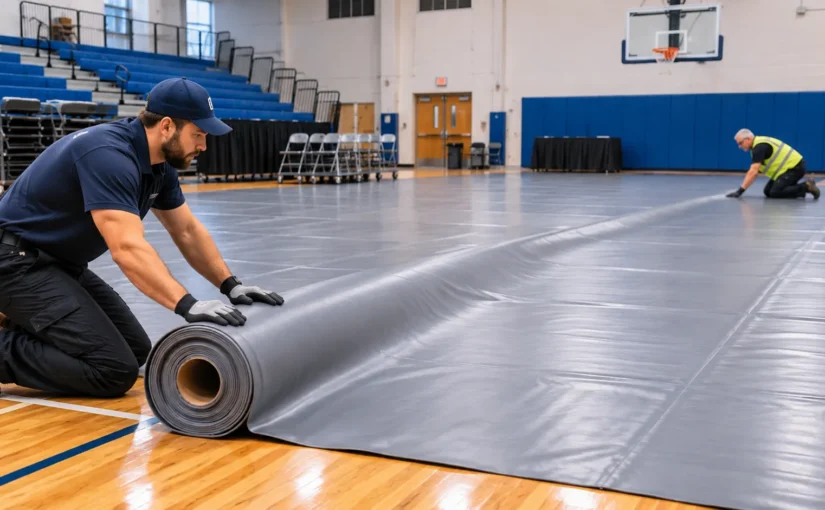
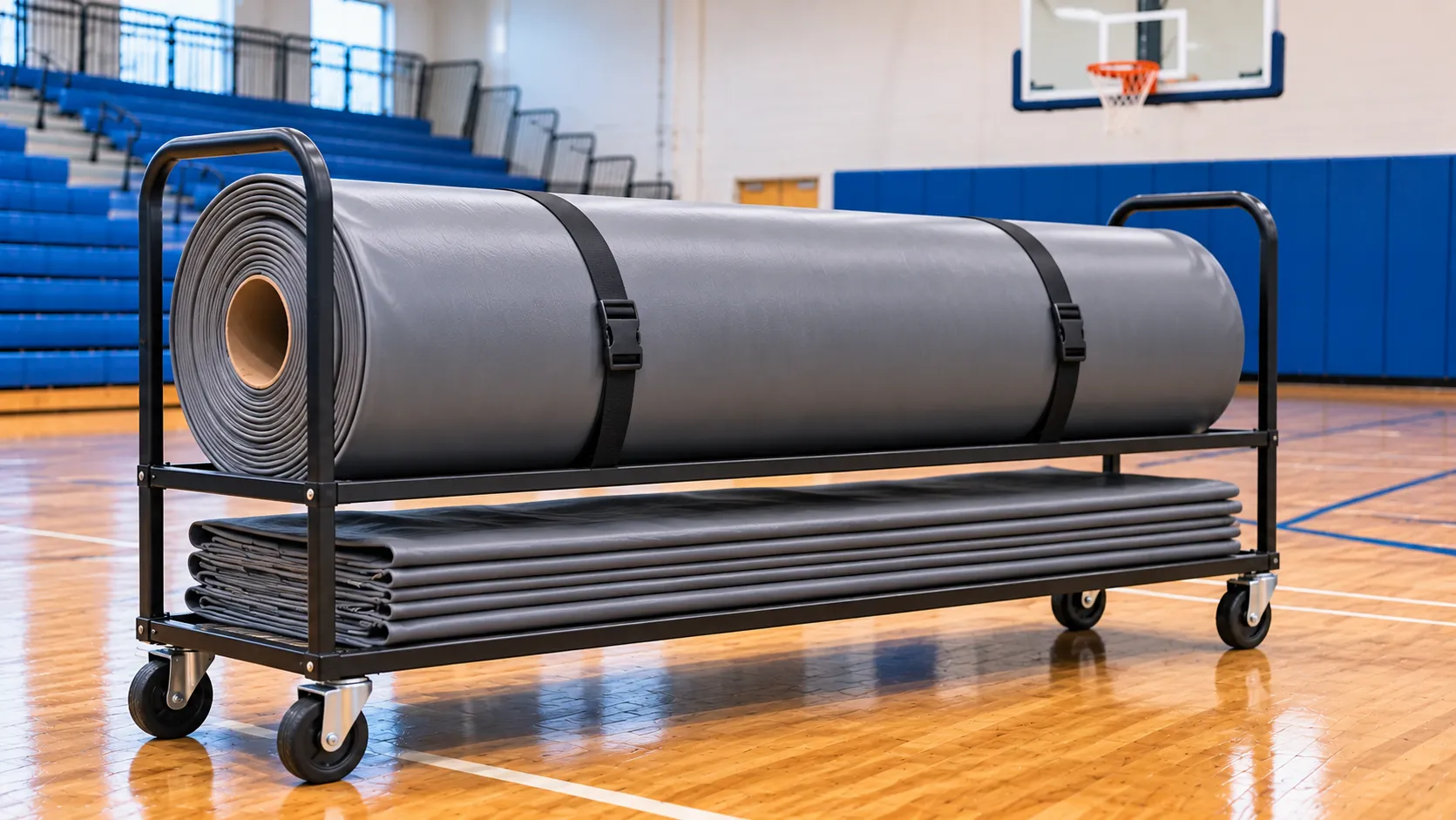
They typically use PVC-coated reinforced fabric supplied in large rolls. Staff unroll the material across the basketball court and connect sections according to the manufacturer’s instructions.

These gym floor tarps are useful for graduation ceremonies, assemblies, and events involving large numbers of chairs.

Advantages include straightforward spill cleanup, reusable construction, and different material weights.

However, waterproof vinyl material does not guarantee that liquid cannot pass through seams.

2. Carpet Rolls

Carpet rolls provide a softer, more finished appearance for concerts, banquets, and formal events.

They typically combine a carpet surface with a protective backing.

Carpet can also help reduce noise from footsteps and moving chairs.

Unlike vinyl covers, carpet rolls require vacuuming and may need deeper cleaning. They must dry completely before storage.

Comparison of gray vinyl and carpet gym floor coverings on a basketball court.
Vinyl and carpet coverings offer different surfaces for protecting basketball gym floors.

3. Protective Carpet Tiles

Large carpet tiles offer flexible floor protection without requiring long rolls.

Products such as Greatmats protective carpet tiles are placed directly beside one another.

These protective tiles are not necessarily interlocking gym floor tiles. Many have straight edges and require no adhesive.

They can be useful when a facility needs to protect different sections of its gymnasium for different events.

However, covering an entire basketball court may require hundreds of tiles and several storage carts.

4. Courtside Runners and Localized Protection

Courtside runners protect smaller areas, including entrances, bench areas, and frequently used walking routes.

They can be a practical option when full-floor coverage isn’t necessary.

However, runners won’t protect an unprotected floor elsewhere in the gym. Facility managers should consider where guests, furniture, and equipment will actually travel.

How to Choose the Right Basketball Gym Floor Covering

Start with the existing floor material.

For a hardwood floor, confirm that the covering’s backing and installation method are approved by the floor and finish manufacturers.

The MFMA also recommends waiting until a new floor finish has fully cured before placing protective covering over it.

Synthetic floors require separate checks. Some rubber-backed products can stain certain synthetic surfaces.

Next, consider event frequency.

For example, FlooringInc’s vinyl cover guidance recommends:

  • 18 oz: Up to approximately six uses annually
  • 22 oz: Approximately 6–12 uses annually
  • 27 oz: Approximately 13–23 uses annually
  • 32 oz: Approximately 24 or more uses annually

These are supplier recommendations, not universal durability ratings.

The ounce figures describe material weight per square yard, not thickness.

For frequent events and repeat deployment, compare tear resistance, backing compatibility, setup speed, and storage requirements rather than relying on weight alone.

How Much Do Basketball Gym Floor Coverings Cost?

Protective gym floor covering prices vary by material, weight, dimensions, and supplier.

The following US prices were documented in the research dossier on November 13, 2026.

Covering Example Material Price
FlooringInc 18 oz vinyl, 10 × 100 ft $1,352.99 per roll
FlooringInc 22 oz vinyl, 10 × 100 ft $1,591.99 per roll
FlooringInc 32 oz vinyl, 10 × 100 ft $2,028.99 per roll
FlooringInc Eco-Roll carpet About $1.34/sq ft
FlooringInc Eco carpet tiles $49.99 per tile
Greatmats carpet tiles $69.99 per tile

These are product examples, not nationwide average prices. Check current prices and availability before ordering.

Sources: FlooringInc vinyl covers, Eco-Roll, and Greatmats tiles.

Additional Equipment and Installation Costs

The covering itself is only part of the investment.

A facility may also need a storage rack, winding equipment, seam tape, cleaning supplies, and delivery arrangements.

For example, the research found a FlooringInc mobile storage rack listed at $4,161.99, although the exact configuration associated with that price wasn’t clear.

Labor costs also depend on the number of workers, the covering system, and how often the gym changes between basketball and other activities.

Always request a complete quote that includes accessories, freight, storage, and any custom branding.

How to Measure a Basketball Gym Floor for Covering

Measure the entire area needing protection, not just the basketball court markings.

Include seating areas, entrances, staging, and equipment routes where necessary.

For a rectangular area:

Length × Width = Floor Area

For example, a 60 × 100-foot event area measures 6,000 square feet.

However, ordering exactly 6,000 square feet of vinyl may not provide enough coverage.

Some vinyl systems require overlapping sections. With 10-foot-wide rolls and 6-inch overlaps, seven 100-foot strips would cover the example width.

That means purchasing 7,000 nominal square feet before any approved trimming.

Carpet rolls and tiles may use different seam arrangements. Ask the supplier for a layout plan before ordering.

For more information about regulation playing areas and clearance, see our basketball court dimensions guide.

How to Install Gym Floor Coverings

Follow the instructions for your specific protective covering system.

  1. Clean the court. Remove dust, grit, moisture, and debris using floor-approved cleaning methods. Our basketball court cleaner guide explains which products and methods suit different playing surfaces.
  2. Inspect the covering. Check for tears, damaged backing, and worn accessories.
  3. Position the material. Roll out vinyl or carpet sections, or place protective tiles according to the layout.
  4. Secure the seams. Use only the approved joining method and tape.
  5. Inspect the finished surface. Check for loose edges, wrinkles, trip hazards, and blocked exits.
  6. Remove carefully. Clean and dry the covering before returning it to storage.

Never assume that ordinary adhesive tape is safe to apply directly to a finished hardwood basketball court.

If you’re planning a new court or renovating an existing one, our basketball court installation guide explains the wider construction process.

Gray vinyl gym floor covering rolled up and secured on a wheeled storage rack inside a basketball gym.
A wheeled storage rack holding protective vinyl gym floor covering.

Safety and Floor Protection

Gym floor protection involves more than preventing scratches.

Slips, Spills, and Trip Hazards

A covering should remain stable under normal event foot traffic.

Inspect seams, exposed edges, and entrances for slipping or tripping hazards.

Even when a vinyl product is described as waterproof, spills may reach the hardwood through poorly secured seams or edges.

The US Access Board also requires accessible walking surfaces to meet applicable stability and slip-resistance requirements.

Heavy Furniture and Equipment

A flexible protective covering cannot automatically prevent dents from heavy equipment.

Inspect chair legs, furniture caps, and cart wheels before events.

For stages, lifts, and other concentrated loads, consult the floor manufacturer about approved load-spreading protection.

Do not assume that a vinyl cover makes heavy equipment safe for every basketball floor.

Fire Safety

Ask suppliers for documented fire-test results and confirm which requirements apply to your building.

A product advertised as fire-retardant is not automatically approved for every school gym or event.

The relevant classification depends on the product, installation, local rules, and building use.

Cleaning and Storing Gym Floor Covers

Clean the covering after each event using the manufacturer’s recommended method.

Vinyl covers may allow surface wiping, while carpet systems generally require vacuuming.

Inspect for tears, damaged seams, and trapped moisture.

Roll flexible covers rather than folding them when the manufacturer recommends rolled storage. Store protective carpet tiles flat when specified.

Before returning the basketball court to athletic use, inspect the exposed floor for debris, moisture, and damage.

Avoid leaving hardwood covered for extended periods. The MFMA warns that prolonged covering can interfere with the wood’s natural moisture balance.

Common Gym Floor Covering Mistakes

Avoid these problems:

  • Buying a cover without checking floor compatibility
  • Confusing permanent vinyl gym flooring with temporary event protection
  • Ordering only the measured floor area without allowing for seams
  • Assuming protective carpet tiles always interlock
  • Applying unsuitable adhesive directly to hardwood
  • Dragging heavy staging or equipment across flexible coverings
  • Ignoring storage rack dimensions and door access
  • Storing wet carpet or vinyl
  • Leaving hardwood covered longer than recommended

A reliable protection system includes the covering, installation procedure, handling equipment, and maintenance plan.

Frequently Asked Questions

How Much Does a Basketball Gym Floor Cost?

A complete basketball gym floor can cost substantially more than temporary floor protection because it involves the playing surface, subfloor, installation, and potentially structural preparation.

Temporary protective coverings are a separate purchase. Documented examples include vinyl rolls costing approximately $1,353–$2,029 per 1,000-square-foot roll, depending on the selected weight.

What to Cover a Gym Floor With?

Use a temporary covering specifically approved for your existing gym floor.

Reinforced vinyl rolls are a practical option for regular events. Carpet rolls suit formal occasions, while large protective carpet tiles offer flexible layouts.

What Material Is Used for NBA Court Flooring?

NBA basketball courts commonly use hardwood playing surfaces, particularly hard maple.

This is different from a temporary basketball gym floor covering, which protects an existing playing surface during non-athletic events.

What Is the Best Flooring to Put in a Gym?

The best flooring depends on the gym’s intended activities.

A dedicated basketball court may benefit from a properly engineered hardwood sports floor. A multipurpose facility may consider hardwood or an approved synthetic sports flooring system.

If the gym already has a suitable basketball floor, a temporary protective covering is generally more relevant than replacing the playing surface just to host occasional events.

Final Thoughts

The best basketball gym floor covering depends on the existing court, event frequency, and storage requirements.

Reinforced vinyl rolls are a practical starting point for regular school events. Carpet rolls offer a more formal appearance, while protective carpet tiles provide flexible coverage.

Before buying, confirm compatibility with the basketball floor, calculate the required coverage, and include storage equipment and installation costs in your budget.

A properly selected and maintained covering can help protect the court while allowing the facility to host other activities.

Basketball Backstop Net | Types, Sizes, Costs & Installation

A basketball backstop net catches many missed shots before they roll into the street, neighboring yards, or landscaping. It sits behind or around your basketball hoop and helps you spend less time chasing balls.

Backstop nets come in several designs, including portable barriers, hoop-mounted attachments, and permanent netting systems. The best choice depends on your available space, basketball system, and where missed shots usually go.

This guide explains the different types, recommended sizes, materials, costs, and installation options for a backyard or driveway basketball court.

What Is a Basketball Backstop Net?

A basketball backstop net is a large mesh barrier designed to stop basketballs from traveling beyond a playing area.

Unlike the small net attached to a basketball rim, a backstop net usually stands behind the hoop. When a missed shot hits the barrier, the net absorbs some of the impact and prevents the ball from traveling farther.

Some basketball backstop nets also redirect balls toward the court. However, they are primarily designed for ball containment, not controlled passing or shooting practice.

A backstop can be useful when your basketball hoop is near:

  • A street or driveway entrance.
  • A neighbor’s property.
  • Windows, vehicles, or landscaping.
  • A fence that missed shots frequently clear.

Backstop nets reduce the need to retrieve basketballs, but they cannot guarantee that every missed shot stays within your yard.

Types of Basketball Backstop Nets

There are four main types of basketball backstop systems. Each offers different benefits depending on your basketball hoop and available space.

Comparison of hoop-mounted, portable, and in-ground basketball backstop nets
Three types of basketball backstop nets.

1. Hoop-Mounted Basketball Backstop Nets

Hoop-mounted backstop nets attach directly to compatible basketball systems.

They usually use brackets, support rods, and a mesh barrier positioned behind the backboard.

For example, the Goalrilla Yard Guard attaches to selected Goalrilla basketball systems. Its installed width is approximately 12 feet 9 inches, with a height ranging from 7 to 9 feet.

These systems are convenient because they work alongside an existing basketball hoop.

However, compatibility is essential. Some attachments only fit specific pole dimensions or basketball hoop models.

Before ordering, check your hoop’s manufacturer, model, and pole dimensions.

2. Portable Basketball Backstop Nets

Portable backstop nets use freestanding frames that can be positioned behind a basketball hoop.

They are useful for driveways, backyard basketball courts, and temporary practice areas.

The GoSports Portable Sports Barrier Net comes in 12 × 9-foot and 20 × 10-foot sizes.

Its manufacturer supplies stakes for grass or dirt and sandbags for hard surfaces.

Portable systems offer several advantages:

  • They do not require a compatible basketball hoop.
  • They can be moved between locations.
  • Many can be disassembled for storage.
  • They may be suitable for multiple sports.

Their main limitation is stability. Always follow the manufacturer’s anchoring and weather instructions.

3. In-Ground Basketball Backstop Nets

In-ground basketball backstop nets use supports anchored into natural ground.

They can provide a wider barrier behind a backyard basketball hoop.

For example, QUICKPLAY’s In-Ground Barrier Net System offers 10-foot-high configurations with different widths.

These systems are particularly useful when you have grass or another suitable natural-ground installation area.

However, they require appropriate ground conditions and installation according to the manufacturer’s instructions.

Check underground utilities before installing ground anchors.

4. Custom and Permanent Basketball Backstop Nets

Custom basketball backstop nets are designed for specific court layouts.

They may use independent posts, cables, walls, or other engineered support systems.

Suppliers such as West Coast Netting provide basketball netting for residential and commercial applications.

Custom systems may be appropriate when a standard net cannot provide enough coverage.

Larger permanent installations should be assessed by a qualified specialist, particularly where wind exposure, structural attachments, or nearby hazards are involved.

Basketball Backstop Net Comparison

Type Best for Main consideration
Hoop-mounted Compatible driveway hoops Model compatibility
Portable Temporary backyard use Anchoring and storage
In-ground Natural-ground installations Soil and ground anchors
Custom/permanent Larger or unusual courts Professional design and installation

What Size Basketball Backstop Net Do You Need?

The correct basketball backstop net size depends on your hoop’s position, the available space, and where missed basketballs travel.

There is no universal required height or width for residential basketball backstop nets.

Basketball Backstop Net Height

Consumer backstop nets commonly include products with heights between approximately 7 and 10 feet.

For example:

  • Pro Dunk: 7-foot-high attachment.
  • Silverback Yard Guard: Approximately 8 feet high.
  • Goalrilla Yard Guard: 7–9 feet high, depending on the section.
  • QUICKPLAY: 10-foot-high barrier configurations.

These are product specifications, not official basketball backstop height standards.

West Coast Netting recommends approximately 10 feet of height as a residential starting point.

A taller net may intercept more high misses, but its support structure must also be suitable for the installation.

Basketball Backstop Net Width

The net should cover the area where basketballs usually escape.

West Coast Netting suggests a residential starting width of approximately 12–15 feet.

However, a narrow driveway may need different coverage from a large backyard basketball court.

Measure the available space and consider shots that travel diagonally past the backboard.

Do not assume that a net’s advertised maximum height applies across its entire width.

Where Should You Position the Net?

Position the backstop where it can intercept missed basketballs without creating an obstacle for players.

Consider:

  1. The basketball hoop’s location.
  2. The court boundaries and player movement.
  3. The net’s width and height.
  4. Support posts, anchors, and frame feet.
  5. Space behind the net for movement when struck.

Avoid placing hard supports where players may run or land.

For additional court measurements, see our basketball court dimensions guide.

Basketball Backstop Net Materials

Basketball backstop nets are commonly manufactured from nylon, polyester, or polyethylene.

Each material can work for ball containment, depending on its construction and intended use.

Material Common applications What to check
Nylon Hoop-mounted and custom nets UV treatment and durability
Polyester Portable and commercial barriers Mesh construction and weather care
Polyethylene Outdoor modular barriers UV treatment and product warranty

The material alone does not determine which net is strongest or most durable.

Compare the actual product specifications, including mesh construction, border reinforcement, and weather instructions.

What Mesh Size Is Best for Basketball?

Mesh size describes the openings between the net’s strands.

Gourock offers 4-inch mesh specifically for basketball barriers, alongside smaller openings such as 2 inches and 1¾ inches.

Smaller openings may be more suitable when the barrier must also contain smaller sports balls.

There is no single mandatory mesh size for every residential basketball backstop.

Choose a net designed for the balls and activities you intend to use.

How Much Does a Basketball Backstop Net Cost?

Basketball backstop net prices vary depending on size, construction, mounting method, and manufacturer.

The following examples were recorded from US supplier listings in November 2026.

Basketball backstop net Size Listed price
GoSports Portable Barrier 12 × 9 ft $119.99
GoSports Portable Barrier 20 × 10 ft $179.99
QUICKPLAY In-Ground Barrier 10 × 10 ft $149.99
Silverback Yard Guard Over 10 ft wide × 8 ft tall $219.95
Pro Dunk Backstop Net 10 ft 6 in × 7 ft $299.00
Goalrilla Yard Guard 153 in wide, variable height $319.95

Sources: GoSports, QUICKPLAY, Silverback, Pro Dunk, and Goalrilla.

These are advertised equipment prices, not installed totals. Prices and availability may change.

Basketball Backstop Net Installation Costs

Portable basketball backstop nets are often designed for owner assembly.

A compatible hoop-mounted attachment may also be suitable for DIY installation when the manufacturer’s instructions are followed.

Custom permanent systems are different.

Installation costs can include:

  • Support posts and cables.
  • Anchors or concrete foundations.
  • Ground preparation.
  • Labor and equipment.
  • Structural design where required.

There is no reliable single nationwide installation price for custom basketball backstop nets.

Request an itemized quote from a specialist for permanent installations.

How to Install a Basketball Backstop Net

The exact installation process depends on the system you purchase.

Person installing a basketball backstop net behind an outdoor basketball hoop
Installing a basketball backstop net behind a backyard hoop.

These steps provide a general planning guide. Always follow the manufacturer’s instructions for the actual installation.

Step 1: Measure the Area

Identify where missed shots normally travel.

Measure the available width and height behind the basketball hoop.

Check for nearby windows, property boundaries, landscaping, and roads.

Step 2: Choose a Compatible System

Decide whether you need a portable, hoop-mounted, in-ground, or permanent backstop.

For hoop-mounted systems, confirm your basketball hoop’s exact model and pole dimensions.

Do not assume that an attachment fits every basketball hoop.

Step 3: Check the Installation Surface

Portable nets may use stakes on natural ground or manufacturer-approved ballast on hard surfaces.

In-ground systems require suitable soil and anchors.

Before driving stakes or digging, follow your state’s 811 utility-location process.

Step 4: Assemble the Supports

Follow the manufacturer’s instructions for connecting the frame, brackets, rods, or posts.

Some systems require two adults and a stable ladder.

Do not modify your basketball hoop or improvise structural attachments.

Step 5: Attach and Position the Net

Secure the mesh using the supplied attachment components.

Check that the net is properly positioned and that its supports do not obstruct players.

Follow the manufacturer’s tensioning instructions.

Step 6: Inspect Before Playing

Check the assembled system for loose connections, instability, and damaged mesh.

Make sure the basketball hoop still operates correctly.

Do not use the backstop if any part appears unsafe.

Basketball Backstop Net Safety and Maintenance

A basketball backstop net should reduce ball escapes without introducing unnecessary hazards.

Inspect the net and its supporting components regularly.

Look for:

  • Torn or fraying mesh.
  • Loose brackets and connections.
  • Rust or damaged supports.
  • Moving or unstable anchors.
  • Gaps that allow basketballs to escape.

Follow the manufacturer’s cleaning and storage instructions.

For example, Goalrilla’s Yard Guard manual requires storage when the product is not being used, during storms, and during aggressive play.

Do not assume that a net marketed for outdoor use can remain installed in every weather condition.

A basketball backstop is also not designed to catch falling players. Keep hard components outside the playing area.

Basketball Backstop Nets vs. Basketball Court Fencing

Basketball backstop nets and court fencing can both help contain missed basketballs, but they serve different purposes.

A backstop net usually covers a specific area behind or around a basketball hoop.

Court fencing typically forms a more permanent boundary around part or all of a basketball court.

A backstop net may be easier to remove or reposition, while fencing can provide a longer-lasting perimeter solution.

However, neither automatically guarantees complete ball containment.

If you need a larger court boundary, read our basketball court fencing guide for fence types, heights, costs, and installation.

Common Basketball Backstop Net Mistakes

Avoid these mistakes when choosing and installing a basketball backstop net.

Buying an incompatible attachment: Check the basketball system’s exact model before purchasing.

Choosing a net that is too narrow: Measure where missed shots actually travel rather than relying on the backboard’s width.

Ignoring the installation surface: Ground stakes and hard-surface ballast are not interchangeable.

Overlooking weather instructions: Outdoor-compatible materials do not guarantee that a portable system can remain outside permanently.

Installing supports too close to players: Keep frames, posts, and anchors outside the playing area.

Confusing a backstop with a rebounder: Some backstop nets redirect balls, but they are not necessarily designed to deliver controlled practice passes.

Frequently Asked Questions

Where Can I Find Backstop Nets for My Basketball Hoop?

You can find basketball backstop nets through basketball hoop manufacturers, sports-equipment retailers, and specialist netting suppliers.

Goalrilla, Silverback, and Pro Dunk sell attachments for compatible basketball systems. GoSports and QUICKPLAY offer separate barrier systems.

Check the product’s dimensions and compatibility before ordering.

Are Basketball Rebounders Worth It?

A basketball backstop with a ball-return function may be worthwhile if you regularly chase missed shots.

However, a backstop is different from a dedicated basketball rebound training system.

Choose based on whether you need ball containment, controlled passing practice, or both.

What Is the Best Basketball Net for a Driveway?

For a driveway with a compatible in-ground hoop, a manufacturer-approved hoop-mounted backstop can be convenient.

For other setups, a freestanding portable barrier designed for hard-surface use may be more suitable.

The best option depends on your hoop, driveway space, and anchoring requirements.

What Is a Backstop in Basketball?

A basketball backstop is a barrier that intercepts missed shots before they travel beyond the playing area.

It commonly consists of mesh netting supported by a frame, posts, or a compatible basketball hoop.

Can You Use a Backstop Net With a Portable Basketball Hoop?

Yes, a separately supported portable barrier can be positioned behind a portable basketball hoop.

However, do not assume that hoop-mounted attachments designed for in-ground basketball systems will fit a portable hoop.

Can a Basketball Backstop Net Stay Outdoors All Year?

That depends on the manufacturer’s instructions.

Some products use UV-treated materials, but portable systems may still require storage during storms or when not in use.

Check the exact product’s weather limitations and warranty.

Final Thoughts

A basketball backstop net can make backyard and driveway basketball more convenient by reducing the number of missed shots that leave the playing area.

For many homeowners, a compatible hoop-mounted attachment or portable barrier is a practical starting point. Larger courts may benefit from custom netting.

Before buying, focus on coverage, compatibility, anchoring, and player safety rather than choosing the largest net available.

The right backstop should suit your basketball court, stop balls where they usually escape, and remain safe throughout its intended use.

Basketball Court Fencing | Types, Heights, Costs & Installation

Basketball court fencing helps keep stray balls inside the playing area, control access, and reduce the chance of balls reaching roads or neighboring properties. It is used around backyard courts, schools, parks, and commercial sports facilities.

Chain-link fencing is a practical starting point for many outdoor basketball courts. Available options range from low 4-foot barriers to 10-foot or taller systems, depending on the court and its surroundings. There is no single regulation fence height for every basketball court.

This guide explains fencing types, heights, installation costs, safety considerations, and how to choose a suitable fence for your court.

What Is Basketball Court Fencing?

Basketball court fencing is a barrier installed around all or part of a basketball court. Its main purpose is usually to contain stray balls, although some systems also help control access to the facility.

A court fence can serve several purposes:

  • Ball containment: Reduces the number of balls leaving the playing area.
  • Access control: Helps manage entry to schools, parks, and private facilities.
  • Property protection: Helps limit balls reaching neighboring properties, buildings, or vehicles.
  • Court separation: Creates boundaries between nearby sports facilities.

Not every basketball court needs a complete enclosure. A backyard hoop may only need netting behind the basket, while a public sports facility may benefit from a full perimeter fence with gates.

The right design depends on the court’s location, available space, and intended use.

Does a Basketball Court Need a Fence?

Not every basketball court requires fencing. Whether a fence is necessary depends on local regulations, the surrounding environment, and the risks associated with stray balls. ASTM F3729-25 provides guidance for assessing fencing around outdoor sport and recreation areas, but it does not impose one national basketball fencing rule.

A fence is particularly useful when a court is close to:

  • Roads or parking areas.
  • Neighboring properties.
  • Buildings and windows.
  • Other sports courts.
  • Areas where spectators gather.

For a backyard basketball court, partial fencing behind the hoop may provide useful ball containment for casual play. Schools and public sports facilities may prefer full-perimeter fencing to manage access and reduce interruptions from stray balls.

However, an ordinary court fence is not a certified vehicle-impact barrier or a guarantee that every ball will remain inside.

Planning a home setup? Our backyard basketball court guide covers layout and space considerations.

Types of Basketball Court Fencing

Several fencing materials are available. Each has different benefits, costs, and maintenance requirements.

Comparison of chain-link fencing, welded-wire panels, and sports netting around basketball courts.

Chain-Link Fencing

Chain-link fencing is a common choice for outdoor sports courts because it provides a durable barrier while allowing visibility through the mesh.

Two common finishes are available:

  • Galvanized chain-link: Steel wire protected by a zinc coating to resist corrosion.
  • Vinyl-coated chain-link: Steel wire with an additional polymer coating, commonly available in black or green.

Chain-link fencing can be used around residential courts, schools, parks, and commercial facilities.

When comparing products, check the wire gauge, mesh opening, coating, posts, and wire-end finish. The Chain Link Fence Manufacturers Institute’s product manual recommends knuckled wire ends for additional safety in playfields and parks.

Welded-Wire Sports Fencing

Welded-wire fencing uses rigid steel panels with wires joined at their intersections. Unlike flexible chain-link mesh, welded panels maintain a fixed shape.

Purpose-designed sports panels may suit courts where a rigid barrier and a particular appearance are preferred. However, ordinary garden fencing should not automatically be considered suitable for repeated ball impacts.

Ask the supplier about impact suitability, panel connections, exposed edges, and replacement parts.

Basketball Court Netting

Basketball netting provides a flexible barrier designed primarily to stop or slow stray balls. It can be installed behind a hoop, along one court boundary, or around a larger playing area. For smaller backyard setups, a basketball backstop net can help contain missed shots without requiring a full court enclosure.

Netting is useful when a full chain-link enclosure is unnecessary. Suppliers offer different mesh openings, heights, and materials. Outdoor netting should be suitable for sunlight and weather exposure.

Important: Ball-containment netting is not automatically suitable for security, child containment, or vehicle protection.

Other Fencing Options

Other possibilities include ornamental metal fencing, wood screening, and solid barriers. These options may suit certain properties, but their appearance alone does not establish their suitability for basketball.

Consider visibility, collision hazards, ball containment, and structural requirements. Indoor basketball facilities may instead use divider nets or retractable curtains to separate courts.

Basketball Court Fencing Comparison

Fence type Main advantage Main limitation
Galvanized chain-link Durable, visible barrier Can corrode if its protection is damaged
Vinyl-coated chain-link Coating and color options Coating can wear or become damaged
Welded-wire sports panels Rigid construction Requires a suitable sports-fencing design
Sports netting Flexible ball containment Usually not a security barrier
Wood or solid screening Privacy and visual screening Visibility, impact, and wind-load concerns

For many outdoor courts, chain-link offers a practical balance of durability, visibility, and ball containment.

How High Should Basketball Court Fencing Be?

Basketball court fencing comes in several heights, but there is no universal regulation height that applies to every basketball court in the United States.

The appropriate height depends on how much ball containment is needed and what lies beyond the fence.

Fence height Possible application
4–6 feet Lower residential boundaries where some ball escape is acceptable
8 feet Taller ball-containment options for residential courts
10 feet Residential or commercial sites needing greater containment
11 feet or more Project-specific public or commercial installations

These are planning examples, not mandatory minimum heights. A 6-foot fence may stop some stray balls but cannot guarantee full containment. An 8- or 10-foot barrier may catch more shots, particularly behind baskets.

For example, a 2025 court project in Beacon, New York, specified 11-foot vinyl-coated chain-link fencing. That does not make 11 feet a national requirement.

If a court is near a busy road or another serious hazard, height alone may not be enough. A designer may recommend additional containment or a different layout.

How Far Should a Fence Be From a Basketball Court?

Basketball fencing should be positioned beyond the playing boundaries so players have room to move without immediately encountering a hard obstruction. This surrounding space is often called the run-off area.

For reference:

  • NCAA men’s basketball rules: At least 3 feet of unobstructed space outside the sidelines, preferably 10 feet.
  • FIBA basketball rules: At least 2 meters (approximately 6 feet 7 inches) of unobstructed space surrounding the court.

These figures apply within their respective playing-rule contexts. They are not universal backyard-fencing laws or interchangeable construction standards. See the NCAA men’s rules and FIBA Official Basketball Rules 2026 for their exact requirements.

When planning a fence, account for posts, gate hardware, braces, and other protruding components. Do not assume protective padding makes inadequate clearance acceptable.

Our basketball court dimensions guide explains the playing area before you plan the surrounding space.

How Much Does Basketball Court Fencing Cost?

Basketball court fencing costs depend on material, height, fence length, ground conditions, gates, and installation requirements.

Published US pricing provides the following examples:

Fencing system Published price per linear foot
6-foot commercial chain-link, installed (9-gauge) $20–$31
8-foot commercial chain-link, installed (9-gauge) $26–$40
10-foot commercial chain-link, installed (6-gauge) $38–$60
Court-builder chain-link allowance; height unspecified $50–$75
Court-builder soft-netting allowance; scope unspecified $25–$30

The first three ranges come from a 2026 commercial chain-link pricing guide. The last two come from Austin Courts & Floors’ published court-building allowances.

These figures are not directly interchangeable. The Austin allowances do not specify fence height or all installation inclusions. None of the figures is a guaranteed local quotation.

Example Basketball Court Fencing Cost

Suppose a hypothetical rectangular enclosure measures 40 × 60 feet. Its perimeter is 200 linear feet.

Using the published $38–$60 installed rate for one specified 10-foot commercial chain-link configuration:

  • Lower estimate: 200 × $38 = $7,600.
  • Higher estimate: 200 × $60 = $12,000.

The illustrative fencing subtotal is $7,600–$12,000, before any work excluded from the base pricing. Gate openings and gate charges may be measured separately.

This is an arithmetic example, not a regulation basketball court layout or contractor quote.

What Affects Basketball Court Fencing Costs?

Several factors can increase the final price:

  • Taller or heavier fencing materials.
  • Difficult excavation or rocky ground.
  • Larger foundations.
  • Pedestrian and maintenance gates.
  • Removing existing fencing.
  • Engineering and permits.
  • Surface repairs and drainage work.
  • Windscreens or other accessories.

Request an itemized quotation identifying the fence specifications, labor, gates, foundations, and any exclusions. If you are building the playing surface too, our basketball court installation guide explains the wider construction process.

How to Install Basketball Court Fencing

Installing basketball court fencing involves more than attaching mesh to posts. The layout, foundations, drainage, and structural requirements must be considered before construction begins.

Workers installing chain-link fencing around an outdoor basketball court

Step 1: Plan the Layout and Check Local Rules

Measure the proposed fence perimeter and identify the playing boundaries. Allow appropriate player clearance and decide where gates will be installed.

Check local requirements covering fence height, setbacks, permits, and property boundaries.

Step 2: Locate Underground Utilities

Before digging, arrange for underground utilities to be located. In the United States, contact the relevant 811 service and follow your state’s notification requirements.

Do not assume the same notice period applies everywhere.

Step 3: Prepare the Ground and Drainage

Clear the installation area and confirm the finished ground level. Identify existing drainage routes.

Fence foundations, bottom rails, and gate thresholds should not block water from leaving the court.

Step 4: Install Posts and Foundations

Install the specified posts and foundations according to the approved design. Concrete-set posts are common, although other systems may be available.

Post spacing and foundation depth depend on fence height, soil, wind exposure, and structural loads. There is no single foundation depth suitable for every basketball court fence.

Step 5: Fit the Fencing and Gates

Attach the selected chain-link fabric, rigid panels, or netting system. Install the specified rails, tension components, fasteners, and gates.

Check that wire ends, connections, and gate hardware do not create unnecessary contact hazards.

Step 6: Inspect the Completed Fence

Before allowing play, check that:

  • Posts and connections are secure.
  • Gates open and latch correctly.
  • Mesh or panels have no dangerous exposed edges.
  • Planned player clearance remains unobstructed.
  • Drainage paths are clear.

Tall fences, challenging ground conditions, and public facilities are good reasons to use qualified professional installers.

Basketball Court Fence Gates and Access

A basketball court enclosure needs suitable access for players and, where necessary, maintenance equipment.

A pedestrian gate may be sufficient for a small private court. Larger facilities may also need wider service gates for resurfacing equipment and other maintenance work.

Gate placement should avoid interfering with the playing area or player run-off space. Public facilities may also need to meet accessibility requirements.

For covered facilities, the ADA accessibility standards generally require at least a 32-inch clear opening at an accessible gate; openings more than 24 inches deep require 36 inches. Route width, hardware, and maneuvering space have separate requirements.

Local authorities should confirm applicable emergency access and exit requirements.

Basketball Court Fencing Safety and Maintenance

Even durable sports fencing needs regular inspection. Look for:

  • Rust or damaged protective coatings.
  • Loose bolts, ties, and fasteners.
  • Broken wires or sharp edges.
  • Leaning or unstable posts.
  • Damaged gates and hinges.
  • Sagging or torn netting.

Clean chain-link fencing when needed using manufacturer-recommended methods. Repair damaged components before they become a hazard.

Can You Add a Windscreen?

Windscreens can provide privacy and reduce visibility through a fence. However, they also increase the area exposed to wind.

A fence designed for open chain-link mesh may not be suitable for an added privacy screen. Have the structure and attachments assessed before installing windscreens, privacy slats, or large banners. The CLFMI wind-load guide explains why fence height, exposure, and configuration matter.

Common Basketball Court Fencing Mistakes

  1. Choosing a fence based only on height. Consider ball escape routes, surrounding hazards, and local rules.
  2. Installing fencing too close to the playing area. Allow appropriate unobstructed space for players.
  3. Comparing incomplete prices. A materials-only kit is not equivalent to a fully installed fence.
  4. Ignoring wind loads. Tall fences and attached screens can require additional structural design.
  5. Using unsuitable fencing materials. Choose systems appropriate for sports facilities rather than assuming any residential fence will work.
  6. Forgetting gates and maintenance access. Plan entrances before foundations and posts are installed.

Frequently Asked Questions

What Is the Recommended Fence Height for a Basketball Court?

There is no single recommended height for every basketball court. Lower 4–6-foot fences may suit some residential situations, while 8–10-foot systems offer taller ball-containment options. Public facilities may use taller fencing depending on the project.

Choose the height based on ball containment needs, nearby hazards, and local requirements.

What Is the Best Fencing for an Outdoor Basketball Court?

Chain-link fencing is a practical starting point because it offers visibility, durable construction, and different height and coating options. However, flexible netting or purpose-designed welded-wire panels may be better for particular sites.

Can You Install Fencing Around an Existing Basketball Court?

Yes, fencing can be added to an existing court if the available space, ground conditions, and foundations allow it. An installer should assess the proposed mounting method and whether player clearance and drainage will be affected.

Can Basketball Netting Replace Chain-Link Fencing?

Netting can replace chain-link for some ball-containment purposes. However, it should not automatically replace fencing needed for security, access control, or other specific safety requirements.

Do You Need a Permit for Basketball Court Fencing?

Possibly. Permit requirements depend on location, fence height, property classification, and local regulations. Contact your local planning or building department before construction.

Can You Install Basketball Court Fencing Yourself?

Some smaller fencing projects may suit experienced DIY installers. However, tall sports fencing requires careful consideration of foundations, wind loads, and player safety. Professional installation is advisable when structural requirements are complex.

Final Thoughts

Basketball court fencing helps contain stray balls, manage access, and separate the playing area from nearby hazards.

Chain-link fencing is a practical starting point for many outdoor courts, while sports netting and welded-wire panels provide alternatives.

Before choosing a system, confirm the fence height, available player clearance, local requirements, and complete installation costs. The right fence fits the site, provides the required containment, and allows players to use the court safely.

Basketball Pole Pads | Types, Sizes, Costs & Installation

Basketball pole pads are cushioned covers that fit around basketball hoop support poles. They help soften accidental contact when players run or fall into the pole.

Basketball pole pads come in different shapes, sizes, materials, and thicknesses. Some cover only the upright pole, while others extend over the baseplate or mounting hardware.

The most important thing is choosing a pad that fits your hoop and covers the areas players might contact. A thicker or more expensive pad is not automatically safer.

This guide explains the different types of basketball pole padding, how to measure your pole, what pads cost, and how to install and maintain them.

What Is a Basketball Pole Pad?

A basketball pole pad is protective cushioning attached to the vertical support post of a basketball hoop.

Most designs contain foam padding covered by vinyl or another protective material. Straps, hook-and-loop fasteners, zippers, or laces hold the padding in place.

Pole padding is commonly used on:

  • In-ground basketball hoops
  • Compatible portable basketball hoops
  • School and recreational basketball equipment
  • Indoor and outdoor basketball courts

The purpose is to cushion accidental contact with the support structure.

However, pole padding cannot eliminate the risk of injury. It does not replace proper hoop placement, secure installation, or sufficient space around the court.

Basketball Pole Padding vs. Other Hoop Padding

Different parts of a basketball system may need different protective products.

Padding type What it covers
Pole padding The vertical support pole
Base padding Baseplates, anchor bolts, or other lower mounting components
Backboard padding Exposed edges of the basketball backboard
Boom padding Parts of the support structure extending toward the backboard
Portable backstop padding Designated areas of a larger portable basketball support system

A standard pole wrap does not necessarily protect exposed anchor bolts or the base of a portable hoop.

For more information about padding around indoor courts, see our basketball court wall padding guide.

Types of Basketball Pole Pads

Basketball pole pads differ mainly in their shape, attachment method, and coverage.

Some are designed for particular hoop models. Others accommodate several pole sizes.

Wrap-Around Basketball Pole Pads

Wrap-around pads fit around the lower section of a basketball pole and are secured using straps or hook-and-loop fasteners.

They are common accessories for residential basketball hoops.

For example, the Silverback Basketball Pole Pad has:

  • A height of 49 inches
  • 1.5 inches of cushioning
  • Hook-and-loop attachment straps
  • Compatibility with specified 4 × 4-inch square and 3.5-inch round poles

Wrap-around designs can be convenient because they usually do not require permanent changes to the basketball hoop.

However, the manufacturer’s compatibility instructions still matter. A pad that wraps around one pole may not fit another pole with a different shape or circumference.

Fitted Square Pole Pads

Fitted pads are designed for square support poles.

They may have shaped sections that sit against the front and sides of the upright.

For example, Douglas offers fitted pole padding for specified 4-inch and 6-inch square poles. Its published design includes:

  • 72-inch pad height
  • 2-inch foam padding
  • Vinyl covering
  • Model-specific sizing

Some fitted pads protect three sides rather than surrounding the entire pole.

Before buying, check whether players can reach any uncovered side.

Round and Cylindrical Pole Pads

Round pole pads are designed for cylindrical support posts.

Some wrap around the pole, while others use a thicker cylindrical design.

The Jaypro PPP-5HP Protector Pad, for example, is designed for a 4.5-inch-diameter pole.

Its published specifications include:

  • 72-inch height
  • 4-inch-thick polyurethane foam
  • Vinyl enclosure
  • Laced attachment

Larger cylindrical pads may be useful in facilities where players can approach a support post from multiple directions.

However, the additional thickness increases the finished outside dimensions. Check that the installed pad will not interfere with nearby equipment or required clearances.

Basketball Pole Pads With Base Protection

Some basketball systems have exposed baseplates, anchor bolts, or support brackets near the bottom of the pole.

A standard upright pad may leave these areas uncovered.

Certain products address this by extending over the lower mounting assembly.

For example, the Goalrilla Universal Basketball Pole Pad is 62 inches tall and includes baseplate coverage.

Other manufacturers, including Douglas, offer separate padding for anchor bolts and lower mounting components.

Check the entire support structure before purchasing. A pad that protects the upright may still leave hard surfaces exposed near the ground.

Basketball Pole Pad Types Compared

Type Main advantage Important limitation
Wrap-around Convenient attachment on compatible poles May not cover the base
Fitted square Designed around specific square-pole dimensions May leave one side exposed
Cylindrical Can provide substantial surrounding coverage Must match pole diameter
Pole and baseplate Covers additional lower hardware Often model-specific
Separate base pad Protects designated anchor or mounting areas May require a matching upright pad

The best type depends on your basketball hoop, its surroundings, and the surfaces that need protection.

How to Choose the Right Basketball Pole Pad

Comparison of round and square basketball pole pads with foam padding shown in cross-section.
Round and square basketball pole pads have different shapes and fitting requirements.

Before comparing prices or materials, identify your basketball hoop’s exact support-pole dimensions.

This is particularly important because manufacturers use different compatibility measurements.

1. Measure Your Basketball Pole

Start by identifying whether the pole is round, square, or rectangular.

For a round pole, measure straight across its outside diameter.

For a square pole, measure the width of one outside face. Do not measure diagonally between the corners.

For a rectangular pole, measure both outside dimensions.

Common published compatibility sizes include:

  • 3.5-inch round poles
  • 4 × 4-inch square poles
  • 5 × 5-inch square poles
  • 6-inch square poles

These are examples of manufacturer-listed sizes, not a complete list of basketball pole dimensions.

If your hoop has multiple pole sections, measure the section where the padding will sit.

2. Check Round vs. Square Compatibility

A pad advertised for a 4-inch round pole does not automatically fit a 4-inch square pole.

Although both measurements include the number four, the shapes have different outside perimeters.

Some manufacturers offer products compatible with both shapes.

For example, Silverback specifies certain round and square pole sizes for its B5451W pad.

Other products are designed for one particular shape.

Always check the exact product’s compatibility information rather than assuming that matching measurements guarantee a proper fit.

3. Choose the Right Padding Height

Basketball pole pads are available in different heights.

Examples from manufacturer specifications include:

Product Published height
Silverback Pole Pad 49 inches
Goalsetter Pole Pad 60 inches
Goalrilla Universal Pole Pad 62 inches
First Team FT75 66 inches
Douglas Fitted Pole Padding 72 inches

These measurements describe how tall the pads are, not how thick their foam is.

A taller pad covers more of the upright, but coverage still depends on how the product fits and where it is positioned.

Consider the areas players could realistically contact.

Also check whether the pad covers exposed lower hardware or requires separate base protection.

There is no single verified residential pole-pad height requirement that applies to every basketball hoop.

4. Check Your Basketball Hoop Model

Your hoop’s manufacturer and model number can help identify compatible accessories.

Look for the model information in the owner’s manual, product documentation, or on the equipment itself.

Check whether the pad interferes with:

  • Height-adjustment handles
  • Cranks or adjustment mechanisms
  • Support braces
  • Transport wheels
  • Baseplates and mounting hardware
  • Important operating instructions or warning labels

Some basketball pole pads have cutouts or notches to accommodate specific equipment features.

If compatibility is unclear, contact the manufacturer before purchasing.

Basketball Pole Pad Materials and Thickness

Basketball pole padding commonly combines a cushioning material with a protective outer cover.

However, manufacturers do not always disclose the same level of detail about their products.

Foam Padding

Foam absorbs and spreads some of the force generated during contact.

Manufacturers use different foam constructions.

Examples include:

Closed-cell foam: Goalsetter specifies closed-cell foam in certain fitted basketball pole pads.

Polyurethane foam: Jaypro lists high-density polyurethane foam in its cylindrical PPP-5HP pad.

High-density foam: Goalrilla describes high-density foam in its square-pole padding, although the published description does not establish its exact chemical composition.

Foam density, thickness, construction, and response to impact can all affect performance.

The term high-density alone does not prove that one product offers better protection than another.

Vinyl Covers and Weather Resistance

Many basketball pole pads use vinyl covers.

These covers help protect the cushioning material from ordinary wear and environmental exposure.

Depending on the product, manufacturers may advertise:

  • All-weather vinyl
  • Weather-resistant construction
  • UV-resistant materials
  • Reinforced seams
  • Custom colors or graphics

Outdoor suitability should be checked for the exact product.

A weather-resistant label does not guarantee that water cannot enter through seams, fasteners, or damaged areas.

For an outdoor driveway hoop, choose padding specifically intended for outdoor use.

What Thickness Should a Basketball Pole Pad Be?

There is no verified universal best foam thickness for every basketball pole.

Published examples include:

Product Published foam thickness
Silverback Pole Pad 1.5 inches
Douglas Fitted Pole Padding 2 inches
Jaypro PPP-5HP 4 inches
Bison Post Padding sold by Gopher 5 inches

These products differ in size, construction, intended use, and coverage.

A thicker pad is not automatically safer.

Meaningful comparisons require suitable impact-testing evidence under comparable conditions.

Also, avoid confusing foam thickness with the overall dimensions of the finished pad.

For example, a product might have 1.5 inches of foam but list an overall depth of 2 inches.

When choosing padding, consider fit, coverage, construction, and the intended playing environment together.

How Much Does a Basketball Pole Pad Cost?

Basketball pole pad prices vary considerably.

Smaller residential accessories generally cost less than larger fitted or institutional padding systems.

The following prices were listed on US manufacturer or retailer websites during research on November 12, 2026.

They are examples rather than a market-wide average.

Basketball Pole Pad Price Comparison

Product Advertised price Published compatibility
Lifetime 0602 $52.50 3.5-inch round poles
Silverback B5451W $84.95 Specified 4-inch square and 3.5-inch round poles
Goaliath B7012CW $94.95 Multiple specified round and square sizes
Spalding SPA0032 $109.99 5- and 6-inch square poles
First Team FT75 $177.10 Specified 4- or 5-inch posts
Goalrilla Square B2700W-1 $189.95 Specified Goalrilla 5 × 5-inch poles
Goalrilla Universal B2611W $269.95 Compatible Goalrilla systems
Goalsetter PC816BL $269.99 Specified Goalsetter 4-inch poles
Goalrilla Deluxe B2607W $319.95 Confirm exact model compatibility

Sources: Lifetime, Silverback, Goaliath, Spalding, First Team, Goalrilla, and Goalsetter.

Prices may change, and availability was not confirmed for every product.

Shipping, taxes, customization, and additional base protection may increase the total cost.

How Much Do Larger Pole Pads Cost?

Larger or specialized products can cost considerably more.

Research examples include:

  • Jaypro PPP-5HP: $408 manufacturer-listed MSRP
  • Flooring Inc Premium 6-Foot Pole Padding: $445.99 for the researched option
  • Greatmats Safety Pole Pad: $489.31 for the researched option
  • Bison Post Pads from Gopher: $829

These products are not directly interchangeable.

They have different dimensions, materials, intended applications, and coverage.

Some are made to order or have special delivery conditions.

Before purchasing a custom pad, confirm the final price, shipping costs, lead time, and return policy.

What Affects Basketball Pole Pad Prices?

Several factors can influence the price:

Size: Taller and larger pads require different amounts of material.

Foam construction: Different foam types, thicknesses, and manufacturing methods affect the finished product.

Coverage: Products that include baseplate or anchor protection may cost more than basic upright wraps.

Attachment system: Straps, fitted enclosures, zippers, laces, and specialized hardware vary by design.

Customization: Team colors, logos, and custom dimensions may increase costs.

Price alone does not establish how well a pad performs during an impact.

How to Install a Basketball Pole Pad

Four steps showing how to wrap, secure, align, and check basketball pole padding.
Illustration of basketball pole pad installation. Always follow the manufacturer’s instructions.

Many residential basketball pole pads use a wrap-around design.

However, installation varies by product.

Always follow the instructions supplied with your exact pad and basketball system.

The following steps describe a general installation process for compatible removable padding.

Step 1: Inspect the Basketball Hoop

Stop play before installing the pad.

Check the support pole for visible damage, loose components, corrosion, or instability.

Do not use padding to hide damaged equipment.

If the basketball hoop is structurally unsafe, address that problem before returning it to use.

Step 2: Confirm the Pad Fits

Check the pad’s model number and compatibility specifications.

Compare them with your pole’s dimensions and shape.

Make sure you have the required straps, fasteners, or other installation components.

Do not force an incompatible pad around the support pole.

Step 3: Position the Padding

Place the pad around the intended section of the basketball pole.

Align its protective surfaces with the areas specified by the manufacturer.

If the product includes a baseplate extension, position that section according to its instructions.

Check that the padding does not cover moving mechanisms or interfere with the hoop’s normal operation.

Step 4: Secure the Fasteners

Close the supplied straps, hook-and-loop sections, laces, or zippers.

Follow the manufacturer’s required attachment method.

For example, a Spalding portable basketball system manual describes wrapping the pole pad around the lower pole and securing it with hook-and-loop straps.

This is an example of one system’s installation method, not a universal procedure.

Some institutional padding assemblies use bolts and other specialized hardware.

Do not drill into a basketball pole or modify its mounting system unless the manufacturer specifically authorizes it.

Step 5: Check the Coverage

Inspect the installed padding from different directions.

Look for:

  • Exposed hard corners
  • Uncovered anchor bolts
  • Open seams
  • Gaps between pole and base padding
  • Loose or incorrectly positioned fasteners

Check that the pad remains in position during a gentle hand inspection.

Do not deliberately collide with the pole to test the padding.

Step 6: Check the Hoop Before Playing

Make sure the padding does not interfere with height adjustment, transport, or other intended functions.

Check the basketball system itself for stability and proper assembly.

For portable hoops, verify the required ballast according to the owner’s manual.

Padding cannot compensate for an unstable basketball hoop.

For broader installation guidance, read our basketball hoop installation guide.

Are Basketball Pole Pads Required?

Requirements depend on the type of basketball facility, the equipment, and the rules that apply.

A residential driveway hoop is not necessarily subject to the same requirements as a college basketball facility.

Residential Basketball Hoops

The research did not establish a universal US legal requirement for every residential basketball hoop to have a separately purchased pole pad.

It also did not establish a universal residential foam-thickness minimum.

However, this does not mean that every unpadded hoop is safe.

Homeowners should consider the position of the support pole, available playing space, exposed mounting hardware, and the manufacturer’s safety instructions.

A properly fitted pad can be a useful additional precaution where accidental contact is possible.

Schools and Competition Facilities

Organized basketball facilities may have specific equipment and padding requirements.

For example, the 2026–27 NCAA Men’s Basketball Rules include requirements for certain backboard support structures and portable backstop bases.

These requirements concern particular equipment configurations.

They should not be interpreted as a universal rule requiring the same padding on every residential basketball pole.

Facility managers should confirm the rules adopted by their competition organization and any applicable building or safety requirements.

What About ASTM Standards?

Several ASTM documents are relevant to sports padding and basketball equipment.

ASTM F2440-24 addresses impact attenuation for wall padding and other indoor structures used in sports facilities.

ASTM F355-26 describes methods for measuring impact attenuation under specified testing conditions.

ASTM F3740-26 provides guidance about padding around playing areas and fixed objects. Its scope has exclusions, so it should not be treated as a universal certification for basketball pole accessories.

ASTM F1882-26 concerns complete residential basketball systems. Its scope excludes separately sold accessories and add-ons.

These documents do not establish that every basketball pole pad meets a particular impact-performance requirement.

A manufacturer should provide suitable product-specific documentation when compliance matters.

For school or recreational facility projects, consult the responsible facility designer or equipment supplier.

How to Clean and Maintain Basketball Pole Padding

Regular inspection helps identify damage that could affect a pad’s fit or coverage.

Maintenance requirements depend on the product and its materials.

Cleaning Basketball Pole Pads

Check the manufacturer’s cleaning instructions before using any product.

For suitable vinyl-covered padding, gentle cleaning may involve:

  1. Removing loose dirt.
  2. Wiping the cover with water and a mild detergent.
  3. Using a soft sponge or cloth.
  4. Removing cleaning residue.
  5. Allowing the padding to dry as directed.

Sportsfield recommends similar methods for its outdoor wall padding, although those instructions should not automatically be applied to every basketball pole pad.

Avoid harsh chemicals, pressure washing, or soaking unless the pad manufacturer permits them.

Maintaining Outdoor Pole Padding

Outdoor basketball pole pads may experience sun exposure, rain, temperature changes, and general wear.

Check for:

  • Cracked or torn vinyl
  • Loose seams
  • Damaged straps
  • Exposed foam
  • Moisture trapped inside the covering
  • Padding that has moved out of position

Some manufacturers recommend removing and storing particular products indoors between uses.

For example, Gopher recommends indoor storage between uses for its Bison post padding to help extend its life.

Follow the instructions for your specific model.

When Should You Replace a Basketball Pole Pad?

There is no verified universal replacement interval for basketball pole padding.

Instead, inspect the product’s condition.

Replacement or manufacturer assessment may be necessary when:

  • Foam becomes exposed or deteriorates.
  • Straps or closures no longer hold securely.
  • The cover has significant tears or open seams.
  • Padding no longer provides its intended coverage.
  • Moisture or mold problems cannot be resolved.
  • The pad no longer fits after equipment changes.

If the underlying basketball pole is damaged, replacing the padding alone will not solve the problem.

Common Basketball Pole Pad Mistakes

Choosing and installing basketball pole padding involves more than matching a product’s color to your hoop.

Here are several mistakes worth avoiding.

Buying the Wrong Pole Size

A pad designed for a round pole may not fit a square pole with the same nominal measurement.

Measure the pole and verify the manufacturer’s compatibility specifications.

Ignoring the Baseplate

Some upright pads leave anchor bolts or mounting brackets exposed.

Inspect the lower support structure and consider compatible base protection where appropriate.

Choosing Based Only on Thickness

More foam does not automatically mean better protection.

The foam material, construction, attachment, coverage, and tested performance all matter.

Blocking Adjustment Mechanisms

An incorrectly fitted pad can interfere with handles, cranks, braces, or transport components.

Check that the basketball hoop operates as intended after installation.

Using Improvised Household Padding

Pool noodles, towels, carpet scraps, and pipe insulation are not established substitutes for purpose-made basketball pole padding.

Their impact performance and attachment security have not been shown to match suitable manufactured products.

Assuming Padding Makes a Hoop Safe

A pole pad cannot fix loose anchors, missing ballast, damaged steel, or unsafe equipment placement.

Treat padding as one part of a broader approach to basketball equipment safety.

Frequently Asked Questions

What Is the Basketball Pole Called?

The upright structure supporting a basketball hoop is commonly called the support pole or support post.

Depending on the equipment, manufacturers may also use terms such as upright or support structure.

The complete basketball system includes other components, such as the backboard, rim, mounting hardware, and base or foundation.

Where Can I Find a Custom Basketball Pole Pad?

Manufacturers and sports-equipment suppliers such as First Team, Douglas, and Goalsetter offer pole-padding options with different sizes, colors, or customization features.

Some products support custom graphics or team branding.

Before ordering, confirm the required dimensions, compatible attachment method, price, production time, and return conditions.

Do Basketball Pole Pads Prevent Injuries?

Basketball pole pads are designed to cushion contact with hard support structures.

However, they cannot guarantee that a collision will not cause injury.

Correct hoop placement, adequate clearance, equipment maintenance, and safe play remain important.

Can You Put a Round Pole Pad on a Square Pole?

Only if the manufacturer explicitly lists compatibility with that square-pole size.

Round and square poles have different shapes and perimeters.

Do not assume a pad will fit simply because the advertised measurements look similar.

Can Basketball Pole Padding Stay Outside All Year?

Some basketball pole pads are designed for outdoor use.

However, weather resistance varies by product.

Inspect the padding regularly and follow the manufacturer’s cleaning and storage instructions.

Outdoor suitability does not mean the pad will last indefinitely without maintenance.

Can You Put Padding on a Portable Basketball Hoop?

Yes, if the padding is compatible with the specific portable basketball system.

Check that it does not interfere with the base, wheels, height adjustment, or transport mechanisms.

Pole padding does not replace the ballast required to stabilize a portable hoop.

How Tall Should a Basketball Pole Pad Be?

Published examples include pads approximately 49 to 72 inches tall.

The appropriate height depends on the support structure, exposed contact areas, and manufacturer guidance.

There is no verified single residential height requirement for every basketball pole.

Can You Make Your Own Basketball Pole Pad?

It is possible to wrap cushioning material around a pole, but that does not establish its protective performance.

Household materials may lack suitable impact testing, weather resistance, or secure attachment.

A purpose-made pad that fits the basketball system is the more reliable starting point.

For public facilities, obtain suitable product documentation and confirm applicable requirements.

Final Thoughts

A basketball pole pad is a useful accessory for protecting the exposed support structure of a basketball hoop.

The right choice depends on your pole’s shape and dimensions, the coverage needed, the pad’s construction, and its compatibility with your equipment.

Before buying, measure your pole, check the manufacturer’s specifications, and inspect the base for exposed hardware.

Most importantly, remember that padding supplements safe basketball equipment installation and maintenance. It does not replace them.

Featured image: Photo by Ildar Sagdejev (Specious), via Wikimedia Commons. Licensed under CC BY-SA 4.0. Resized and converted to WebP.